THE LATEST
« »
Showing posts with label Bipartisan. Show all posts

Tuesday, February 11, 2014

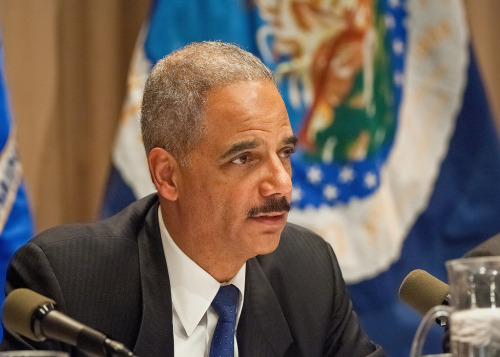
Atty. Gen. Holder joins bipartisan effort to restore voting rights to ex-felons

Eric Holder

CNN: One of Washington’s oddities of late is Attorney General Eric Holder’s liberal social justice goals finding unity with the tea party movement’s curb-big-government proposals led by Sens. Rand Paul and Mike Lee.

On Tuesday, the alliance is on display as Holder, for the first time as attorney general, calls for states to automatically restore voting rights to prisoners who are disenfranchised upon conviction. Paul, who supports voter ID laws Holder has sought to block, has pushed to overturn disenfranchisement laws that he says affect too many black men.

Holder, Paul and Lee are pushing to overhaul the nation’s criminal justice system, seeking to discard mandatory minimum sentences for non-violent crimes and reduce costly prison spending. The three are appearing Tuesday at a Georgetown Law School forum sponsored by the Leadership Conference on Civil and Human Rights.
“Eleven U.S. states restrict or completely deny voting rights to prisoners even after they’ve completed sentences, probation and parole,” the report goes on. “Florida, among the most restrictive, bars 10% of its population from voting as a result of such laws. About 5.8 million Americans are prohibited from voting because of current or previous felony convictions, Holder says.”

The laws hurt African-Americans disproportionately, since our criminal justice system is rife with institutional racism and sentences are grotesquely distorted by class privilege. According to report, this means that “nearly one in 13 black adults across the US” are denied their right to vote because of a past felony conviction.

It’s a bit of a mystery why Lee and Paul want to address this issue, since even acknowledging it knocks out a leg supporting the GOP’s War on Voting. Republicans have had a difficult time finding cases of voter fraud to support their push for voter ID. And a very large proportion of those they do find are a result of these laws. A guy is sentenced in Wisconsin, for instance, where voting rights are restored and later moves to Florida, where they’re stripped. He tries to vote and finds out he can’t — oops! That’s technically “voter fraud,” despite the fact that there was no intent to defraud anyone. If felons’ franchise are restored, a massive chunk of their already meager collection of “voter fraud” stories evaporates.

Still, give them credit for wanting to do the right thing. Stripping the right to vote from felons for life is meant to capitalize on the criminal justice system’s racist bent, in order to suppress minority voting. The sooner this tactic dies, the better for democracy.

[photo via U.S. Department of Agriculture]

Monday, February 25, 2013

Bipartisan effort to draft universal background check bill stumbles — slightly

Greg Sargent:

Okay, I’ve got some more detail for you on the status of Senate negotiations over the plan to expand the background check system.

A couple weeks ago I reported that the bipartisan group of Senators negotiating this deal — Tom Coburn, Joe Manchin, Chuck Schumer, and Mark Kirk — were 95 percent of the way there. That was reiterated in press accounts over the weekend. But then Coburn, who is central to the discussions because of his sterling “gun rights” record, went on TV and said the deal is not close — that the sticking point has to do with whether to keep records on sales.

Here’s the situation, according to sources familiar with the discussions. The sticking point right now only concerns guns sold in rural or remote areas. The Senators have agreed on a key provision: How background checks would be expanded to most private sales. The way it would work is that in most cases, if you want to sell me a gun, you and I would go to a federally licensed dealer, who would run the check for a fee and okay the sale. In that case, a record of the sale would be kept by the gun store — which is already how it works for existing background checks. Coburn, according to the sources, does not have a problem with this.

However, Coburn wants private buyers and sellers in remote areas (how this would be defined is not yet clear) to be able to remotely get federal dealers to run the background check, via an internet portal. This is the central focus of negotiations right now. In these cases, Coburn says, no record of the sale should be kept. Dems disagree, arguing that some kind of record is necessary for enforcement.

OK, so this is stupid, right? What’s happening here is that Republicans and other gun nuts have been fearmongering about a “gun registry” that could be used by Adolph Joseph Hitlerstalin to send black gun grabbin’ helicopters to gun owners’ houses. I trust I don’t need to explain to most of you why this is on the insane side of the real world concerns dial.

But is it really a hang up? Well, probably not. It’s more Coburn putting up a fight over a trivial detail to show the gun nuts that he’s still on their side. And frankly, if they’ll gullible enough to buy the paranoid gun registry/gun grabbing fantasy, they’re dumb enough to let Coburn pull the wool over their eyes.

“[T]his sticking point is not insurmountable,” Sargent reports. “After all, depending on how you define ‘remote area,’ the concession Coburn wants (no records on those sales) might only end up impacting a small minority of sales, ones that would not be criminal in any case (since the person passed the check). If this were done, you’d still see a dramatically expanded background check system.” Not much of a downside there.

The only downside I can see is the aforementioned enforcement problem. Since there would be no record of these gun sales, what we’re really talking about are background checks on the honor system. Democrats are very correct to be concerned about this. But this sticking point might be overcome by defining who’s a gun dealer and who’s just some guy selling off a squirrel rifle he doesn’t use anymore. It seems to me that the kind of private sales that Coburn’s worried about don’t happen all that often, so maybe anything more than two or three sales a year should qualify you as a dealer — in which case records would have to be kept.

No one’s hair’s on fire over this, so it seems more like a speed bump than a road block.

Sunday, February 21, 2010

President's Weekly Address: Some Good, Some Bad

President Obama's weekly address centers on healthcare reform and a bipartisan summit to deal with it.


[Transcript]


A couple of thoughts enter my mind. First, that the following really shoots down the GOP argument that we ought to throw everything out the window and start over:

The other week, men and women across California opened up their mailboxes to find a letter from Anthem Blue Cross. The news inside was jaw-dropping. Anthem was alerting almost a million of its customers that it would be raising premiums by an average of 25 percent, with about a quarter of folks likely to see their rates go up by anywhere from 35 to 39 percent.

Now, after their announcement stirred public outcry, Anthem agreed to delay their rate hike until May 1st while the situation is reviewed by the state of California. But it’s not just Californians who are being hit by rate hikes. In Kansas, one insurance company raised premiums by 10 to 20 percent only after asking to raise them by 20 to 30 percent. Last year, Michigan Blue Cross Blue Shield raised rates by 22 percent after asking to raise them by up to 56 percent. And in Maine, Anthem is asking to raise rates for some folks by about 23 percent.

The bottom line is that the status quo is good for the insurance industry and bad for America. Over the past year, as families and small business owners have struggled to pay soaring health care costs, and as millions of Americans lost their coverage, the five largest insurers made record profits of over $12 billion.

And as bad as things are today, they’ll only get worse if we fail to act...


These aren't things that might happen or that will happen if we don't do anything, these are things that have happened. The Republican line can be expressed as "What's the big rush?" -- which seems more than a little out of touch. The ship is sinking and they're arguing that we ought to build new buckets to bail with, because they don't like the ones we have now.

The second thing that struck me was this:

It’s in [the spirit of bipartisanship] that I have sought out and supported Republican ideas on reform from the very beginning. Some Republicans want to allow Americans to purchase insurance from a company in another state to give people more choices and bring down costs. Some Republicans have also suggested giving small businesses the power to pool together and offer health care at lower prices, just as big companies and labor unions do. I think both of these are good ideas – so long as we pursue them in a way that protects benefits, protects patients, and protects the American people. I hope Democrats and Republicans can come together next week around these and other ideas.


The second one may be a good idea, but the first one is definitely not. Insurance companies operate under different laws in different states, meaning that allowing insurers to compete across state lines is a de facto deregulation of an industry that's in need of more regulation, not less. Companies will relocate in the least regulated states, meaning layoffs in other states. Other states will change their laws. Competition won't be among insurers, it'll be among states. The president adds the caveat that he'd be open to this "so long as we pursue them in a way that protects benefits, protects patients, and protects the American people," but that would require some sort of national board and new federal regulations -- something Republicans would never go for. Without some sort of national standard, the least regulated state becomes the national standard and we begin a race to the bottom.

Still, I suppose this highlights the president's party's attempts at bipartisanship and the other party's refusal of it. But you'd think that would be obvious by now. Here's hoping this bad idea dies.

Search Archive:

Custom Search