THE LATEST
« »
Showing posts with label economics. Show all posts

Thursday, April 17, 2014

Racism, inequality is literally in the very air we breathe

Raw Story - Study: People of color breathe air that is 38 percent more polluted than white people’s
Raw Story: A study released by the University of Minnesota this week indicated that people of color are exposed to air that is 38 percent more polluted than the air breathed by white people.

In an interview with The Minnesota Post, the study’s lead researcher, Julian Marshall, an associate professor of civil engineering at the University of Minnesota, said that “the main [factors in how polluted the air breathed in was] are race and income, and they both matter. In our findings, however, race matters more than income.”

When Marshall compared the exposure gap between high-income Hispanics and low-income whites, for example, the nitrogen dioxide (NO2) concentrations were still higher among high-income Hispanics.

“We were quite surprised to find such a large disparity between whites and nonwhites related to air pollution,” Marshall told The Minnesota Post. “Especially the fact that this difference is throughout the U.S., even in cities and states in the Midwest.”
That income inequality is a factor in the purity of the air you breathe is nothing new. When it comes to polluting industries, people are protected by their wealth and power — you’re never going to see an incinerator or a fracking site move in next door to a multi-million dollar mansion. This is one of the ways in which income inequality is a very real problem that creates very real dangers. It’s not about people being “jealous” of rich people — despite what Republicans and blowhards on Fox News tell you — it’s about very real dangers that people at the bottom of the ladder face every day. If we really were a society dedicated to equality, the poor person’s health would be as much a concern as the rich person’s. They voices would be equal. But they aren’t — and people are literally and inarguably suffering because of it.

The disparities in race paint an even darker picture. There, it’s not as much about income, but about status. People of color breathe dirtier air because they’re automatically lower on the societal ladder, regardless of income. These are both very real problems and the people who bring them up aren’t just bellyaching. Conservatives who talk about free market solutions should take a closer look at what this market does and ask themselves if the people at the bottom rung — measured by income, race, or both — are by any stretch of the imagination free.

Or are they just worthless peasants in a nation that’s increasingly governed by a new aristocracy based on income and a racist class system? When working people have to literally consume the waste of the rich, calling those working people “free” is a ridiculous joke.

Here’s your “trickle down economics.” That’s not money that’s trickling down.

Wednesday, April 09, 2014

Privatization fail: WI public schools outperform private voucher schools

Classroom
This is all actually very simple; public schools don’t have to turn a profit. Many private scools do. For the record, cost + profit is greater than just cost. In order for a for-profit to compete with a nonprofit on a cost basis, the for-profit i going to have to cut corners — i.e., what conservatives spin as “efficiency.” Here we see the results of these efficiencies; a half-assed education program that’s the predictable outcome of taking money away from actual education to line the pockets of pointless middlemen and bean counters.

So the proper way to accept this news is, “Well duh, of course…” If you’re having a different reaction, maybe you didn’t go to public school.

[photo by Bart Everson]

Friday, August 09, 2013

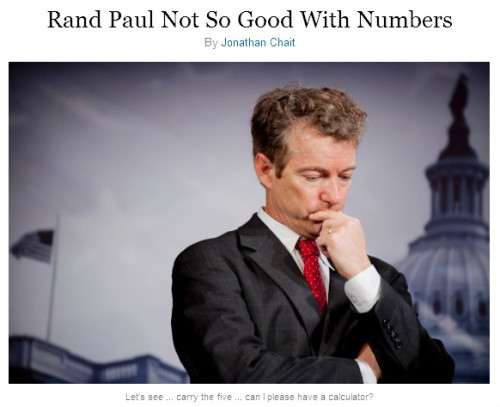
Pretend economic ‘realist’ Rand Paul shows he has no idea what the hell he’s talking about

Jonathan Chait - Rand Paul Not So Good With Numbers
Jonathan Chait: Josh Green asks Rand Paul about his rather extreme budget proposal, and Paul replies that it’s necessary because the only alternative is Trillion-Dollar Deficits As Far As the Eye Can See:
You know, the thing is, people want to say it’s extreme. But what I would say is extreme is a trillion-dollar deficit every year. I mean, that’s an extremely bad situation.
Some good news for Senator Paul — we’re not running a trillion-dollar deficit anymore. The deficit this year is forecast at $642 billion, per the Congressional Budget Office, which also forecasts the deficit to fall to $560 billion next year and $378 billion the following year.

For Rand (and Ron) Paul, the dread specter of fiscal collapse and hyperinflation is more of a generalized fact of life than something that depends on particular “numbers.” The whole political rise of the Pauls since 2008 owes a great deal to the economic crisis and the resulting spike in the deficit, which drove large numbers of people to join the freak-out bunker where the Pauls have resided all along. Of course Rand Paul isn’t going to notice the apocalypse is receding — its imminent appearance is a fixed piece of his worldview.
The interviewer then went on to ask Paul, “Who would your ideal Fed chairman be?” He named two dead guys, one of whom would completely disagree with him about monetary policy.

The problem with pretending to be an economic whizkid is that sooner or later you’re going to have to open your mouth and blow your cover.

Tuesday, July 23, 2013

Guess where it’s hardest to escape poverty?

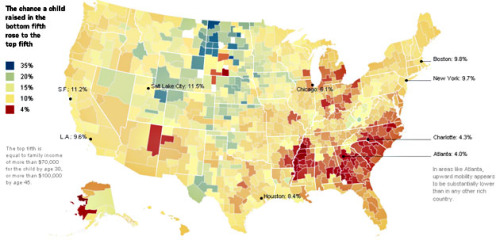
NYT poverty trap heat map
David Leonhardt provides us with the above map showing the rate at which people escape poverty at various locations in the United States. And the deep south red states are appropriately red. For all their talk about giving people in poverty “a hand up, not a hand out," they seem to do a remarkable lousy job of doing either. And of course, another region hard hit is the rust belt, once a union stronghold where fair wages prevailed, which has fallen into hard times with the decline in organized labor and the resulting hits to the economy and tax base that comes with slowly sinking wages.

In Wisconsin, we too have a spot of red. That’d be Milwaukee County mostly, formerly run by our current Governor, Scott Walker. While it’s tempting to blame Milwaukee’s situation on Walker, it’s probably truer to blame it on former Gov. Tommy Thompson, who pioneered “welfare reform" that cuts people off of assistance for life after a set period of time. After Thompson’s legislation passed, rent-to-own, car title loan, and payday lender outfits sprouted up all over the place like mushrooms, leaving people trapped in poverty by tying a boat anchor to their legs in the form of a debt trap. Billed as a way to help people escape poverty, welfare reform has had the opposite result — leaving me to wonder if feeding the poor to usurious wolves wasn’t the plan all along. It’s telling that right next to the Milwaukee area on the map is the Madison area, where those crazy, pie-in-the-sky liberal economic policies nearly double the rate at which people escape poverty comparatively. Where Milwaukee’s rate is 5.6%, Madison drags the percentage — despite the anti-poor policies of the state — up to 10.2%.

In any case, we need a reversal of Republican policies, rather than a continuation of them. “Poor kids don’t exactly have a great chance in life no matter where they live, but in the South, they have almost no chance at all," writes Kevin Drum. “If you take a look at the policy preferences of Southern governors and legislatures, that’s apparently exactly the way they like it."

Friday, July 12, 2013

If Walmart doesn’t open DC store, so what?

ThinkProgress’ Bryce Covert tackles the story about a Washington DC living wage bill and Walmart’s threat to halt construction of a new store if it goes through. First off, there’s no question that Walmart can and should pay a living wage. Many Walmart employees rely on food stamps to make ends meet, meaning Walmart’s getting a free ride on the backs of the taxpayers. In addition, Walmart claims to be a “job creator," but according to Covert, "[T]he evidence from past cases paints a different picture: Walmart destroys as many jobs as it creates and doesn’t stimulate local businesses."

The showdown between DC and the largest private employer in the country closely mirrors one that took place between it and the city of Chicago in 2006. That city had also proposed a living wage law, but after Walmart threatened to abandon plans to open up stores the mayor vetoed it.

The lessons from the fallout of that battle have implications for DC. After the Walmart opened up on the west side of Chicago, economist Joseph Persky of the University of Illinois Chicago and his colleagues conducted a rigorous study of the impact on employment by going door to door for three annual surveys. They talked to businesses in the area that had overlapping product lines with the giant retailer before and after the opening. The study found that businesses in the immediate proximity of Walmart had about a 40 percent chance of closing in the two years following the opening. The chance of closing decreased the further away a business was from Walmart. These figures are likely conservative, the authors write, as they weren’t able to look into how many new businesses failed to open thanks to Walmart. But a different study of Florida found that the company’s entrance suppressed new business openings.

This didn’t just mean losing area businesses, but also losing jobs. The researchers estimated that nearly 300 jobs were lost after Walmart opened. The company asserts that it employed 426 workers at its store, 310 of whom were “sales associates,” many of which were probably full-time positions. Therefore, the researchers gave a generous estimate that just 320 full-time jobs were created – just about equal to the number of jobs destroyed by the store opening up.
Bottom line: Walmart’s predatory business model guarantees that no new jobs are created. And their poor treatment of their workers guarantees that the jobs that shift to Walmart actually pay worse. The result is a paycut for workers and a hit to the local economy. The idea that Walmart — or any retailer for that matter — “creates" jobs is BS. Demand ceates jobs, retailers merely respond to demand. And low wages reduce demand.

So, if Walmart tells DC they’ll pull out if the city passes a living wage ordinance, the city should say, “Good riddance." They’re better off without them anyway.

[photo via Wikimedia Commons]

Sunday, March 03, 2013

Texas Republicans learn that some spending cuts are just way too expensive

Texas Tribune:

The fight to restore family planning financing that was cut from the Texas budget in the last legislative session has taken a turn toward primary care. Republican state senators have proposed adding $100 million to a state-run primary care program specifically for women’s health services, an effort that would help avoid a political fight over subsidizing specialty family planning clinics.

“It’s a much better way to treat the women because they don’t just have family planning issues,” said Sen. Bob Deuell, R-Greenville, a family physician who has advocated for increasing primary care services for women.

Using taxpayer dollars to finance family planning services has become politically thorny in Texas, largely because of Republican lawmakers’ assertions that the women’s health clinics providing that care were affiliated with abortion providers. In the fiscal crunch of 2011, the Legislature cut the state’s family planning budget by two-thirds, with some lawmakers claiming that they were defunding the “abortion industry.” Researchers at the University of Texas at Austin found that more than 50 family planning clinics closed statewide as a result of lost financing.

Now, amid estimates that the cuts could lead to 24,000 additional births in 2014-15 at a cost to taxpayers of $273 million, lawmakers are seeking a bipartisan solution to restore financing without ruffling feathers.

Of course, what’s actually happening here is that they’re looking at restoring family planning funding, but putting it under primary care services in hopes of keeping the anti-family planning religious nutjobs from noticing a retreat from their extremist position. After gutting Planned Parenthood funding, Texas is facing a public reproductive healthcare crisis — in the form of a wave of unplanned pregnancies. You really didn’t need a crystal ball to see that one coming. It’s obvious and it’s exactly what critics of the move predicted would happen.

But, in addition to showing how the GOP War on Women is boneheaded and wrong, it also shows that some spending is cheaper than the consequence of cutting that spending. It may cost a lot to keep a dam in good repair, but it’ll cost a lot more if the dam gives way. This is the same principle. You spend money now to make sure women have access to adequate reproductive health care or you pay later for the increased health spending and poverty that comes with unexpected pregnancies. I don’t care how many times you say, “But the Bible says…” you can’t have your cake and eat it too.

Long story short, when a liberal talks about investing in America’s future, we’re not just spreading horse manure — we really do mean making investments in America’s future. You either deal with problems now or spend one helluva lot more money dealing with them later. And, of course, by dealing with it now, you avoid a whole lot of screwed up lives and futures.

Contrary to the rightwing stereotype, liberals aren’t about spending taxpayer money because of some hippy-dippy “Oooh, we gotta all love each other, baby” stuff. This is hardheaded realism. It’s the people who think we can cut everything and anything who are the head-in-the-clouds dreamers. Don’t want to pay taxes to support family planning? Sucks to be you, but you’re going to do it. Because this is America and in America we try do what’s in America’s best interests. I pay for nuclear weapons I hate, you can at least pay for some birth control. You’re not special.

If the Texas retreat from the extremist position teaches us anything, it’s that Republican claims to fiscal genius aren’t just ridiculous, they’re hilarious.

Friday, March 01, 2013

GOP busy trying to save you from economic recovery, prosperity

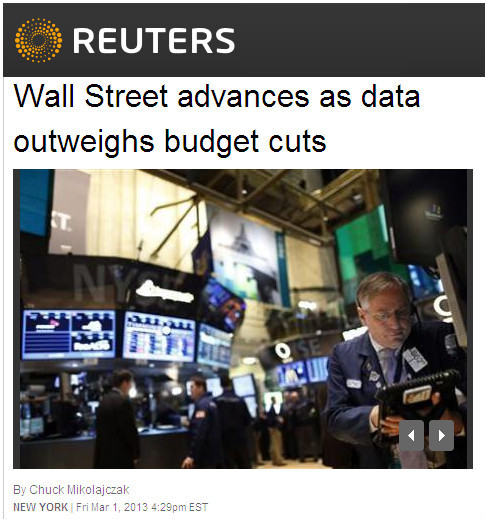
Reuters:

Stocks advanced modestly on Friday, leaving the S&P 500 with slight gains in a volatile week as strong economic data overshadowed growth concerns in China and Europe and let investors discount the impact of expected government spending cuts.

Stocks opened sharply lower for the session as Asian factories slowed and European output fell, but most of the losses evaporated after a report showed manufacturing activity expanded last month at its fastest clip in 20 months.

Consumer sentiment also rose in February as Americans turned more optimistic about the job market.

Asia and Europe are getting shaky, American demand is about to take an $85 billion hit, but all this bad news is not enough to offset the good news — American manufacturing on the rise in response to growing consumer confidence. That’s what Republicans are crowing about today; saving you from headlines like this. Because, you know, President Obama’s stewardship of the economy is such a nightmare of incompetence, right?

European-style austerity is what’s called for here — and never mind that this austerity is what’s responsible for the European and Asian decline. That’s the new GOP way; attack demand wherever it rears its ugly head!

Wednesday, February 06, 2013

Everything GOP says about economics proven wrong — again

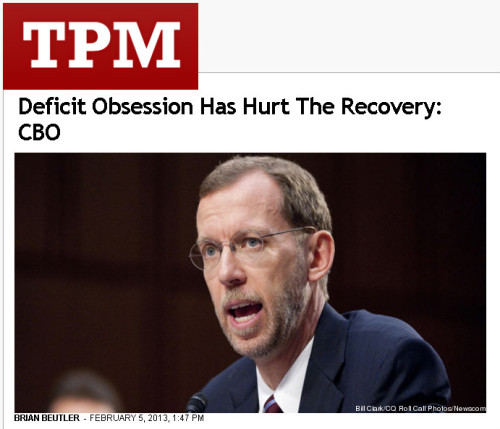
Talking Points Memo:

Here’s the buried lede from the Congressional Budget Office, which on Tuesday released its Budget and Economic Outlook for the coming decade: D.C.’s deficit obsession has been quite effective at cutting deficits at the expense of the still-struggling economy.

“[E]conomic activity will expand slowly this year, with real GDP growing by just 1.4 percent,” according to CBO’s projections. “That slow growth reflects a combination of ongoing improvement in underlying economic factors and fiscal tightening that has already begun or is scheduled to occur-including the expiration of a 2 percentage-point cut in the Social Security payroll tax, an increase in tax rates on income above certain thresholds, and scheduled automatic reductions in federal spending. That subdued economic growth will limit businesses’ need to hire additional workers, thereby causing the unemployment rate to stay near 8 percent this year, CBO projects.”

In other words, intentional efforts to reduce annual deficits and stabilize the debt are working. But if you retrain your gaze from the government’s balance sheet to the real economy, you’ll see the impact of that austerity is fewer people working and slower growth. According to CBO, the recovery won’t really pick up steam until next year, and the economy won’t have recovered until the end of 2017, when it will reach its output potential, and unemployment will fall to 5.5 percent.

CBO notes that the U.S. hasn’t experienced six consecutive years with unemployment exceeding 7.5 percent in over 70 years.

So if you cut spending, you slow economic growth. This shouldn’t surprise anyone who actually understands the principles of supply and demand, since slashing spending means slashing demand. Still, Republicans like to argue that cutting spending is the super-responsible thing to do in a struggling economy because… Well, they don’t often get to the “because.” It’s just because, so shut up already. If they were forced to take truth serum, we’d find out that it’s because Barack Obama says the opposite.

You might remember a Commerce Department report last month that showed a drastic decrease in defense spending was responsible for unexpectedly slow job growth — again, cutting spending = cutting demand = hamstrung economic growth.

As always, reality has a liberal bias.

Friday, October 26, 2012

Fox News accidentally reports economic truth


Hilarious.
Steve Benen:
The economy grew a little faster than expected in the third quarter (July through September), with the GDP report showing 2% growth. I suggested earlier that the right would likely start pushing conspiracy theories, and I wasn't kidding.

Fox News' Stuart Varney suggested that third quarter economic growth as measured by the Commerce Department was a conspiracy to help reelect President Obama, pointing to the fact that economic growth was driven in part by increased government spending. [...]

Varney, discussing the figure on Fox News, raised doubts about the numbers, saying: "Dig deeper. Look inside that report, and you see a big 9.6 percent jump in government spending. There is some suspicion that these numbers have been juiced by government spending deliberately in that quarter, in the report, right before the election."

In fairness to Varney, it looks like I predicted the wrong conspiracy theory. I thought Fox News and others would accuse Commerce Department officials of manipulating data and deliberately releasing fraudulent figures, just as the right did with the Bureau of Labor Statistics.

It turns out, Varney is pushing a different conspiracy theory -- that government spending went up, which in turn "juiced" economic growth.

Of course, there's a term for that particular "conspiracy theory" -- Keynesian economics. After years of shrieking that you can't spend your way to economic recovery, Varney's basically saying, "Of course the GDP numbers are up -- government's cheating by spending their way to economic recovery! They're using Keynesian Jedi economics tricks to fool us into believing that Keynesianism works!"

What we're seeing here is the rare 360-degree spin. Varney's twisted his story so badly that he's turned everything completely around in one orbit -- and now finds himself accidentally reporting the reality that Keynesian spending boosts economic growth. I'm surprised Fox producers didn't cut him off and put up a "technical difficulties" message over the screen.

Sunday, September 23, 2012

Not fighting global warming is really expensive

New York Times:

Jeff Rothschild’s machines at Facebook had a problem he knew he had to solve immediately. They were about to melt.

The company had been packing a 40-by-60-foot rental space here with racks of computer servers that were needed to store and process information from members’ accounts. The electricity pouring into the computers was overheating Ethernet sockets and other crucial components.

Thinking fast, Mr. Rothschild, the company’s engineering chief, took some employees on an expedition to buy every fan they could find — “We cleaned out all of the Walgreens in the area,” he said — to blast cool air at the equipment and prevent the Web site from going down.

That was in early 2006, when Facebook had a quaint 10 million or so users and the one main server site. Today, the information generated by nearly one billion people requires outsize versions of these facilities, called data centers, with rows and rows of servers spread over hundreds of thousands of square feet, and all with industrial cooling systems.

In a yearlong investigation into the energy usage by online companies, NYT found “the information industry is sharply at odds with its image of sleek efficiency and environmental friendliness.”

The problem seems to be one of sheer laziness: “Online companies typically run their facilities at maximum capacity around the clock, whatever the demand. As a result, data centers can waste 90 percent or more of the electricity they pull off the grid, The Times found.” Rather than monitor demand and adjust capacity accordingly — like a utility — data centers just run everything at full blast all the damned time.

And it’s here that the argument that reducing our dependency on fossil fuels means economic disaster dies. That’s why this argument is made mainly by energy producers — oil and coal companies, for example. If everyone cut back on energy usage, coal companies would make less money, sure. But everyone else would make more. If we put real effort — I’m talking Apollo project effort — into reducing energy consumption, we’d have energy for dirt cheap (not only because we use less, but because supply and demand would drop the price at the same time) and a cleaner environment. Meanwhile, all this new technology would give birth to entire new economic sectors.

New technologies, new industries, new markets — yup, sounds like a real economic nighmare, huh? Much better to keep shoveling coal and money into 20th century furnaces to keep the 21st century world running full-freakin’-throttle, 24-7 — whether we need it to or not.

Monday, September 17, 2012

Tax cuts for the rich don’t help the economy

Or, as economists put it, “no shit, Sherlock.”

Talking Points Memo:

There is no clear correlation between tax cuts for high earners and economic growth, according to a new study by Congress’ nonpartisan policy analyst.

“There is not conclusive evidence, however, to substantiate a clear relationship between the 65-year steady reduction in the top tax rates and economic growth,” concluded a report by the Congressional Research Service released Friday. “Analysis of such data suggests the reduction in the top tax rates have had little association with saving, investment, or productivity growth.”

The findings are pertinent to a central debate in the presidential election, wherein President Obama is pushing to end the Bush-era tax cuts on high incomes, while his Republican challenger Mitt Romney insists on cutting rates across the board 20 percent below current policy. Democrats contrast the tax hikes of the 1990s and ensuing economic growth with the tax cuts of the 2000s and relatively meager gains that followed. Republicans, meanwhile, argue that the recovery is weak because the economy remains shackled by regulatory and tax burdens.

The study delves into the last 65 years of U.S. tax policy pertaining to high earning Americans — including top marginal rates on income and capital gains taxes — and how it impacts their decision-making. The conclusion: cutting effective taxes on the rich doesn’t boost economic growth, but it does correlate with rising income inequality.

This is all very simple to explain: the conservative argument that employers hire as many people as they can afford is bullshit — just like you’ve always suspected. The fact is that the rich love money too much, so any extra money they get is saved, not spent. Meanwhile, consumers are the “job creators,” not employers. Employers hire as many people as they need — no more and no less. And the reason they need those employees is to meet consumer demand.

Republican economic arguments are nonsense. They’ve always been nonsense. The only reason they even exist is to counter liberal arguments — which in turn are the reality-based arguments. That conservative economic plans do nothing should surprise no one in the world.

Search Archive:

Custom Search