THE LATEST
« »
Showing posts with label environment. Show all posts

Thursday, February 20, 2014

Study shows fossil fuels, nukes unnecessary to provide the world with energy

PhysOrg: New research has shown that it is possible and affordable for the world to achieve 100 percent renewable energy by 2030, if there is the political will to strive for this goal.

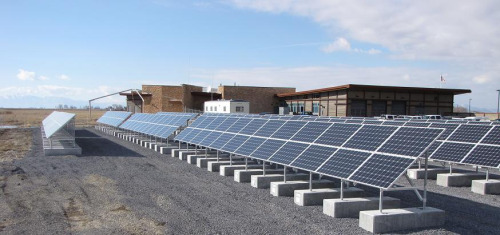
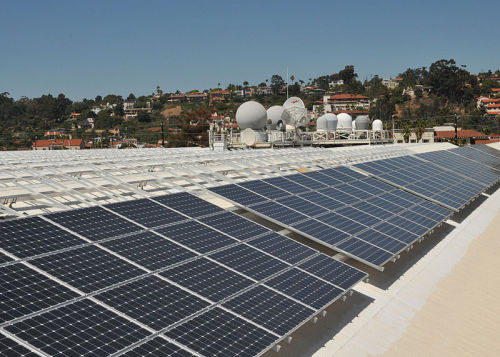
Achieving 100 percent renewable energy would mean the building of about four million 5 MW wind turbines, 1.7 billion 3 kW roof-mounted solar photovoltaic systems, and around 90,000 300 MW solar power plants.

Mark Delucchi, one of the authors of the report, which was published in the journal Energy Policy, said the researchers had aimed to show enough renewable energy is available and could be harnessed to meet demand indefinitely by 2030.

Delucchi and colleague Mark Jacobson left all fossil fuel sources of energy out of their calculations and concentrated only on wind, solar, waves and geothermal sources. Fossil fuels currently provide over 80 percent of the world’s energy supply. They also left out biomass, currently the most widely used renewable energy source, because of concerns about pollution and land-use issues. Their calculations also left out nuclear power generation, which currently supplies around six percent of the world’s electricity.
I wasn’t extremely surprised that we could get by without fossil fuels. What got my attention was that nuclear power was left out of the equation as well. A lot of people have been trying to paint nuclear as a necessary evil, saying we’d have to use “clean” nuclear power to reduce carbon emissions. This study proves them wrong.

Turns out we can power the whole planet without using energy from an industry that produces what may be the most dangerous toxic waste known to humanity. Good to know.

[photo via Wikimedia Commons]

Wednesday, February 12, 2014

Industry on the march in West Virginia!

Charlie Pierce - Yet Another Spill In West Virginia
Charles Pierce: The Invisible Hand is just never going to get tired of slapping West Virginia around.
More than 100,000 gallons of the coal slurry is believed to have flowed into Fields Creek, a tributary of the Kanawha River, officials said. Inspectors are testing the water to determine exactly how much leaked into the creek, the officials said. The spill at Patriot Coal was caused when a valve inside a slurry line malfunctioned, the state environmental protection officials said. Containment efforts by Patriot Coal began immediately, and cleanup activities are underway, said Janine Orf, a vice president at Patriot Coal. State EPA spokesman Tom Aluise said the water in the county was safe to drink, though West Virginia American Water has a “do not use” alert in place for pregnant women in the Kanawha Valley after an unrelated January 9 spill.
So there’s a new spill, about which nobody has to worry, so they can relax and just worry about the spill in January, which is “unrelated” to the latest one, unless you count the fact that they’re all connected by centuries of environmental damage and neglect, and forty years of deregulatory frenzy. Unless you count that.
If you happen to be a woman and pregnant, this water is most definitely not for you. But for everyone else, it’s perfectly healthy. Hell, it’s probably even nutritious. Don’t ask how that’s supposed to work, it just does. In any case, every glass includes a little something to chew on, so what are you complaining about?

Time to drink up. Everything’s fine. At least, until Liberty Eagle Flag Industries dumps toxic fly ash in school lunches somehow. But we can’t put regulations on the job creators and if Paul Revere’s Freedomgasm Chemical Company can’t sometimes put toxic coal slurry into your groundwater, then freedom is dead and the terr’ists have won.

Thursday, February 06, 2014

In North Carolina, another success story for the 'hands off' approach to environmental regulation

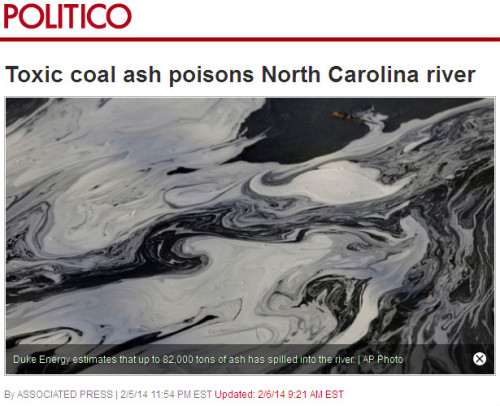
AP - Toxic coal ash poisons North Carolina river
Associated Press: Canoe guide Brian Williams dipped his paddle downstream from where thousands of tons of coal ash has been spewing for days into the Dan River, turning the wooden blade flat to bring up a lump of gray sludge.

On the river bank, hundreds of workers at a Duke Energy power plant in North Carolina scrambled to plug a hole in a pipe at the bottom of a 27-acre pond where the toxic ash was stored.

Since the leak was first discovered by a security guard Sunday afternoon, Duke estimates up to 82,000 tons of ash mixed with 27 million gallons of contaminated water has spilled into the river. Officials at the nation’s largest electricity provider say they cannot provide a timetable for when the leak will be fully contained, though the flow has lessened significantly as the pond has emptied.

An Associated Press reporter canoed downstream of the spill at the Dan River Steam Station and saw gray sludge several inches deep, coating the river bank for more than two miles. The river had crested overnight, leaving a distinctive gray line that contrasted with the brown riverbank like a dirty ring on a bathtub.

Williams, a program manager with the Dan River Basin Association, worried that the extent of the damage might not be fully understood for years.

“How do you clean this up?” he said, shaking his head as he churned up the ash with his paddle. “Dredge the whole river bottom for miles? You can’t clean this up. It’s going to go up the food chain, from the filter feeders, to the fish, to the otters and birds, to people. Everything in the ecosystem of a river is connected.”
According to the AP, the sludge is a “witches’ brew of toxic chemicals, including lead, arsenic, mercury and radioactive uranium.” But here’s the kicker:

Environmentalists and government regulators have been warning for years that the 31 ash ponds at Duke’s power plants in North Carolina had the potential for calamity, especially after a similar pond in Kingston, Tenn., burst open in 2008.

“Even without a spill, these settling ponds have been releasing continuous contamination into the rivers downstream from coal-fired power plants,” said Avner Vengosh, a professor of geochemistry at Duke University, which was named for the same family that founded the power company.
So the ponds leak chemicals into drinking water, have resulted in a previous spill, and now this disaster. But this is North Carolina, so how much do you want to bet that absolutely nothing will change as a result?

After all, going after the “job creators” for taking a big toxic crap in your drinking water would be class warfare. And we can’t have that.

Tuesday, August 06, 2013

More than 2 years after it began, Fukushima nuke disaster not even close to being over

IAEA inspectors at Fukushima Daiichi
Reuters: Highly radioactive water seeping into the ocean from Japan’s crippled Fukushima nuclear plant is creating an “emergency" that the operator is struggling to contain, an official from the country’s nuclear watchdog said on Monday.

This contaminated groundwater has breached an underground barrier, is rising toward the surface and is exceeding legal limits of radioactive discharge, Shinji Kinjo, head of a Nuclear Regulatory Authority (NRA) task force, told Reuters.

Countermeasures planned by Tokyo Electric Power Co are only a temporary solution, he said.

Tepco’s “sense of crisis is weak," Kinjo said. “This is why you can’t just leave it up to Tepco alone" to grapple with the ongoing disaster.

“Right now, we have an emergency," he said.
The Fukushima Daiichi incident began in 2011. It’s still happening today. Tell me again how “safe and clean" nuclear energy is the key to the future. When an industry creates waste so toxic it must be buried in the heart of a mountain, calling it “clean" is a joke. And when we look at the ongoing disaster in Japan, “safe" is quite a punchline as well.

[photo by IAEA Imagebank]

Friday, May 24, 2013

German brewers demand moratorium on fracking

Raw Story: The Association of German Breweries sent a letter this week to German Prime Minister Angela Merkel and six Cabinet Ministers demanding a moratorium on fracking until more research can be carried out to allay concerns of water contamination.

Germans have had strict standards for beer brewing since the 1516 implementation of the Bavarian “Reinheitsgebot,” or purity law, which allowed only malted barley, hops and water to be used in the brewing of beer. (Yeast was allowed later, after it was discovered.) But the strict nature of the law, which remains in effect today, means that no additives of any kind are allowed — especially contaminants in the drinking water.

The breweries association spokeperson, Marc-Oliver Huhnholz, told Bloomberg, “We are concerned that fracking endangers the brewing water that more than half of Germany’s breweries take from private wells.” He explained to The Telegraph, “The water has to be pure and more than half Germany’s brewers have their own wells which are situated outside areas that could be protected under the government’s current planned legislation on fracking.”

Merkel’s coalition in government, which includes Germany’s two mainstream conservative parties, reportedly plans to offer fracking legislation before the September 22, 2013 elections that would allow fracking in some areas but not in others. The main opposition party, the Social Democrats, support a moratorium and the Green Party prefers an outright ban on the practice. The head of the Green Party in parliament, Bärbel Höhn, told Das Bild in January, “Fracking with toxic chemicals is prohibited. But the government wants to allow it in 86 percent of the region. That makes more than just the brewers concerned.”
The Reinheitsgebot is one of the earliest consumer protection laws, preventing brewers from charging premium beer prices for crap. Contrary to the article, it doesn’t apply to all beers, just most Bavarian lagers — wheat beers like Paulaner’s are obviously legal. Still, unknown fracking chemicals in the water could be seen as violating the standards — you don’t want that crap in your Spaten.

What this story does is demonstrate how one industry impacts another. When you start carving out exceptions to law to benefit one industry, you often wind up injuring another. And, of course, fracking is a stupid idea anyway, since it risks earthquakes — in addition to the pollution that results in flammable tapwater.

[photo via Wikimedia Commons]
Saturday, April 06, 2013

The ongoing 20-year disaster: Pipeline accidents common, expensive


Desmog Blog recaps the past few days:
Cleanup efforts are currently underway in three separate oil spills that have occurred in the last ten days.

On March 27th, a train carrying Canadian tar sands dilbit jumped the rails in rural Minnesota spilling an estimated 30,000 gallons of black gold onto the countryside.

Two days later a pipeline ruptured in the town of Mayflower, Arkansas, sending a river of Albertan tar sands crude gurgling down residential streets. And news is just breaking about a Shell oil spill that occurred the same day in Texas that dumped an estimated 700 barrels, including at least 60 barrels of oil into a waterway that leads to the Gulf of Mexico (stay tuned for more on that).

This week a Canadian Pacific freight train loaded with oil derailed, spilling its cargo over the Northwest Ontario countryside. Originally reported as a leak of 600 liters, the CBC reported on Thursday that the estimated volume of the spill has increased to 63,000 liters.
So, is this just a string of bad luck? Hardly. What’s happening is that the administration is making a decision on the Keystone XL pipeline soon and that puts pipeline news in the spotlight. The fact is that these sort of incidents are incredibly common.

Over the last 20 years, pipeline incidents have caused over $6.3 billion in property damages. On average during this time period there were more than 250 pipeline incidents per year, without a single year where that number dropped below 220. During that time, more than 2.5 million barrels of hazardous liquids were spilled and little more than half of those spilled amounts were recovered in cleanup efforts.
Let’s see… 250 per year… Yup, looks like the past ten days were actually a good week and a half, by oil safety standards. I wouldn’t be surprised if someone somewhere didn’t get some sort of a plaque for it.

These incidents happen all the damned time and usually only get covered by local news. Billions in property damage, untold environmental damage, and toxic dangers to peoples’ health — more than once a week on average, every week, every month, every year, year after year after year. This is normal. Hell, this is better than normal. We don’t have to worry about when the next environmental disaster will hit — America’s just one big, unreported environmental disaster. One that never ends because we’re too freakin’ stupid to end it.

Not only can’t Keystone XL possibly be safe, it would just serve to make us more dependent on a source of energy that’s killing us. That alone should be enough to reject it.

[photo via Wikimedia Commons]

ExxonMobil oil spill results in ExxonMobil chemical spill

Grist:

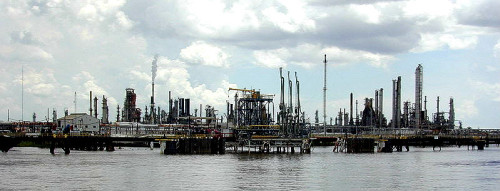
Even as ExxonMobil was mopping up after its disgusting tar-sands oil spill in Arkansas on Wednesday, it spilled an unknown amount of unknown chemicals — possibly hydrogen sulfide and cancer-causing benzene — during an accident at a riverfront refinery in Louisiana.

The Chalmette refinery chemical spill might have gone unnoticed, except that it stank out the city of New Orleans and several nearby parishes, leading to state and federal investigations (we told you about that mysterious odor yesterday). Frankly, ExxonMobil’s track record here sucks: The same refinery spilled 360 barrels of crude oil in January.
Keep in mind that this chemical spill would never have happened if it wasn’t for the oil spill. This means that each spill creates the possibility of related spills and that the Chalmette spill could conceivably result in yet another spill someplace else. In other words, we risk environmental disaster every time there’s an environmental disaster. Cleaning up catastrophe creates new possibilities for catastrophe.

Look, we’re going to have to quit using fossil fuels eventually. Since they’re finite resources, that’s a given. Likewise, as they get more and more scarce, supply and demand will keep jacking the price up. And, of course, the whole thing is dangerous and dirty.

Add all those facts together and it’s hard to see how it’s not a good idea to start transitioning away from fossil fuels now. I mean in a meaningful way. In a deliberate way with the end of fossil fuels being the goal. We’ll save ourselves a lot of money in the long run and we’ll be doing the environment (and our health) a big favor, all by getting a head start on something we’ll have to do eventually anyway. We’ll create new jobs, new markets, and new technologies. We can start working on developing and perfecting alternative energy technology now or we can keep doing this stupid, dirty, pointless, and increasingly expensive stuff until it becomes impossible to continue and then switch over to alternatives.

Seems like a no-brainer to me. Unfortunately, there’s no shortage of people who seem to have no brains.

[photo via Wikimedia Commons]

Wednesday, March 27, 2013

Report: fracking causes earthquakes

Raw Story:

A study published Tuesday in the scientific journal Geology links the magnitude 5.6 earthquake that hit Oklahoma in November 2011 to natural gas drilling operations nearby that were using an extraction technique called fracking, which requires massive quantities of wastewater be injected into underground reservoirs.

The quake struck between Tulsa and Oklahoma City just before 11 p.m. on Sunday, November 6, 2011, causing serious damage to homes and even buckling a highway. Tremors were reportedly felt in 17 states — as far away as Illinois — and dozens of subsequent aftershocks kept Oklahomans up all night.

Researchers at the University of Oklahoma and Columbia University noticed that the quake was one of five greater than magnitude 5.0 that occurred in the continental interior of the U.S. in 2011. Studying the aftershocks of the Oklahoma quake, they discovered that the rupture plane of the quake, or the site where the tension built up and then violently shifted, was within 200 meters of fracking injection sites and nearly one meter from the surface.

Interestingly, the study’s findings show that while most seismic activity linked to newly installed fracking wells is minor, tension between fault planes can build for years, resulting in unexpected interactions with wastewater sites.

In this case, researchers said 18 years worth of fluid injection in sealed oil wells “lowered effective stress on reservoir-bounding faults,” causing several fault planes to give way in sequence after the initial quake hit, which is why the quake was so substantial.

“Massive earthquake” is a tad bit hyperbolic, but “dangerous” would definitely have fit. Global warming, flammable tapwater, earthquakes… Are we really this desperate for natural gas? After all, there isn’t actually a shortage. Basically, the reason that the fracking industry exists is so that the fracking industry can exist. It’s not something we actually need to do. It’s just a form of specialized drilling to avoid competition with the standard method.

I say we just knock it off altogether. Seriously, when you’re causing earthquakes, it’s just a stupid thing to do.

Monday, February 25, 2013

Prosecutors: BP’s Deepwater Horizon was ‘The Well From Hell’

The Guardian:

The man in charge of BP‘s ill-fated Deepwater Horizon rig warned his boss that staff were operating in “chaos, paranoia and insanity” just days before a fatal blowout killed 11 men and caused the worst oil spill in US history, a New Orleans court heard on Monday.

In opening arguments Michael Underhill, the lawyer representing the US Department of Justice, said BP knew it was drilling a “well from hell” but that its managers refused to deviate from a “course of corporate recklessness” that ultimately led to the fatal blowout at the Gulf of Mexico well.

The company was guilty of “willful misconduct,” he said. It had calculated it needed $7bn (£4.6bn) to pay shareholders their dividend and put immense pressure on staff to save money and drill faster in order to reach that target, he said. “A safety corner cut a day saved was a $1m saved for BP,” said Underhill.

The civil trial began on Monday in courtroom 268 of the US district court in New Orleans after the apparent collapse of settlement talks over the weekend. This case is the first of two and will decide how this tragedy happened and who caused it to happen. A second will determine exactly how much oil was spilled. BP faces a potential fine of $17.6bn. The case will be decided by judge Carl Barbier.

“The tragedy of this case,” said Underhill, is that it was caused by failures that “didn’t even amount to pocket change.” He told of problems that could’ve been solved with “as little as a 10-second phone call” or “a 30-second walk down to the tool pusher.”

An email showed the jawdropping depth of the negligence of Deepwater Horizon managers.

Underhill said the “extraordinary document … explains why 11 men needlessly lost their lives”. On 17 April, [well team leader John] Guy told [operations manager David] Sims that BP’s well site leaders “were at wits’ end” and there was a “huge level of paranoia that was riding chaos”. The well was proving impossible and they were “trying to make sense of all the insanity”. “The operation is not going to succeed if we continue in this manner,” he warned.

Sims responded that he had to go to dance practice in a few minutes. “I’ll be back soon and we can talk. I’m dancing to the Village People,” he wrote.

Just amazing. If the result weren’t such a tremendous tragedy, this would all be comically absurd.

[image source]

Thursday, February 21, 2013

All new US generating capacity so far this year has been renewable

The Hill:

Renewable energy accounted for all new electric capacity added in the United States last month, according to the Federal Energy Regulatory Commission.

In all, 1,231 megawatts of new generating capacity were installed in January. Of that total, wind provided 958 megawatts, solar chipped in 267 megawatts and biomass contributed 6 megawatts.

That’s a marked difference from January 2012, when coal led the way with 808 megawatts of the 1,693 megawatts added. Natural gas followed with 445 megawatts, and wind tossed in 276 megawatts to take the pole for renewables.

On Wednesday, President Obama sought to expand promotion of renewable energy by reviving the Commerce Department’s Renewable Energy and Energy Efficiency Advisory Committee.

Weird, I’m not noticing the sky falling here. Looks like we can add a bunch of renewable generation without even noticing it. In fact, this is actually nothing new.

“The U.S. already doubled its electric generating capacity from renewable sources between 2008 and 2012, according to a Bloomberg New Energy Finance and Business Council for Sustainable Energy report released last month.”

You didn’t notice a thing. It was completely painless.

[image source]

Tuesday, July 13, 2010

The CityCar

Dang, I was going to include this in the roundup and I didn't. Got sidetracked with getting all sarcastic about the Heritage Foundation and The Grapes of Wrath.

Anyway, a reader sent me a link to some educational videos from the National Science Foundation, including this one about a really cool idea called the CityCar. Check this thing out:


I've always liked the idea of motors in the wheels; it seems to me that when you're braking, they should be able to recapture some energy by acting as generators (you'll remember that a generator and a motor are one in the same). There are seven videos in all in what seems to be an ongoing project. Go check them out.

Friday, June 25, 2010

"I'd like to take the CEO of BP and jam his face in that pile on the beach"

From the St. Petersburg Times:

Kevin Reed, 36, of Pensacola breaks down and weeps upon seeing the oil-defiled shores of Pensacola Beach on June 23, 2010. Reed's father taught him to swim in these waters, and Reed just taught his five year old son to swim here. "This will never be the same," he says. "I'd like to take the CEO of BP and jam his face in that pile on the beach."


Where no comment is necessary, I won't offer any.

Wednesday, June 23, 2010

Oil Leak Coming Down in Rain Along the Gulf Coast

"It's raining oil... It is literally raining oil," a Louisiana resident reports.


And that's just a normal rain. We're heading into hurricane season.

Wednesday, March 31, 2010

Insight into White House Reasoning on Offshore Drilling

President Obama's decision to expand offshore drilling is getting a lot of criticism, much of it deserved. We know that there isn't enough to make a dent and that expanding drilling risks environmental damage, so there are big potential costs for very little gain. That said, two emails give us insight into the White House's reasoning here.

First up, a note from Sen. Kerry's office to Greg Sargent (emphasis Sargent's):

Kerry spokesperson Whitney Smith emails:

“President Obama once again today reaffirmed his commitment to passing comprehensive energy and climate legislation.

“In the difficult work of putting together a 60 vote coalition to price carbon, Senator Kerry has put aside his own long-time policy objections and been willing to explore potential energy sources off our coasts as part of a suite of alternative solutions. He and his colleagues are committed to find acceptable compromises on onshore and offshore oil and gas exploration, conducted in an environmentally sensitive manner that protects the interests of the coastal states.

“They’ve met with Senators who oppose drilling and those who support it and they’ve worked for months to determine the best solutions.”

Kerry and Senator Lindsey Graham are developing climate change legislation that they hope will attract bipartisan support in the Senate. As the statement above suggests, Kerry believes that drilling could help win over some GOP support for this approach.


Next, an email from an unnamed "Hill staffer" to Steve Benen, which may be a bit more revealing (emphasis mine):

Obama preempts the other side's most resonant arguments, which forces them to come up with more and more extreme claims in order to differentiate themselves. In the end, he occupies the reasonable middle ground and his opponents are Palinized. It doesn't always work -- on the national security/gitmo/Miranda stuff, for example, it turns out the utter extreme positions the right is left with given the centrist ground Obama has staked out turns out to be fairly popular. But even there, the Administration has had reasonable success pushing back on the Miranda nonsense and, because they effectively occupy the tough, pragmatic middle ground, they routinely get cover from non-crazy Republican national security voices, which has helped blunt the force of these issues. (I understand that the term "middle ground" is very slippery and dangerous here, but I basically use it to mean policies that, before the great crazy of 2009 had broad consensus support from large portions of both parties and the Broder/Friedman/Brooks axis.)

At the same time, the policy is a tailored, measured version of what the Republicans have urged -- so, yes, the headline is, 'Obama Allows New Offshore Drilling/Presses For Energy Independence,' but at the same time, California/Oregon/Washington where opposition is strongest isn't included, and there are environmentally-friendly changes to Alaska leasing policy announced at the same time. And again, as we've seen before, Republicans are sort of forced to twist and parse, and even to oppose things they have long supported, just because the Administration hasn't gone far enough.

Finally, by announcing the drilling policy without seeking to extract concessions, the Administration makes clear that it is their policy and they are the centrist/flexible/pragmatic ones -- making it harder for Republicans to argue that they accomplished this or that they forced Obama to do it. [...]

[O]f course, if there was any reason to believe that Republicans would engage in normal negotiation/compromise, then I see why holding this back and trading it for support of a broader package would make sense. But does anyone really think there are Republicans to negotiate with on this stuff? And if Republicans do come to the table, Obama still has plenty of room to give, including by simply agreeing to sign a law that makes proposals like this a matter of statute, not executive discretion.


I find the second email sort of troubling, good political strategy aside. It reminds me of a sort of Clintonesque triangulation. The problem with Clinton was that what began as a political strategy to get things done ended up as an ideology that hinged on preemptive compromise. Yes, we do now have Republicans defending things like "don't ask, don't tell," where previously they'd argued that it would be the end of the world. But DADT sucks... So there's that.

Still, the climate bill is just so important that it's hard to find fault with any strategy that moves it forward. I guess we'll see how this pans out.

Saturday, January 09, 2010

The Real Climate Lie -- That There's a Scientific Debate on the Subject

To listen to the media, you'd believe that scientists are pretty much split on whether or not humans cause global warming. But a graph that comes to us from Information is Beautiful (via Grist), shows that opinions are a lot more lopsided than you've been led to believe (click image for larger chart):

graph


Roughly 90% of all published scientists, regardless of their field, believe that humans cause global warming. To make things even worse for deniers, 99% of published climatologists -- the experts in this field -- believe the same thing.

Of course, the media -- obsessed with a phony "objectivity" -- gives equal time to nutjobs. So the next time you see a talking head show, you'll see one reality-based head and one denier head arguing, creating the impression that the scientific community is split on the question along a 50/50 line.

But to accurately represent the scientific community in general, there would have to be nine reality-based heads to one denier. Among climate scientists, the breakdown would be ninety-nine scientists who believe in human caused warming to one lone nutjob who thinks it's all a crock.

I feel pretty safe in concluding that the opinion of 99% of all climatologists represents the consensus position. It's not the science behind global warming that's a crock, it's the idea that there's a serious debate about it; that's just a lie. Among climate scientists, the percentage is high enough to legitimately call the debate over.

Sunday, December 13, 2009

NEWSFLASH: RNC Chair Michael Steele Says Something Stupid Again

You really think he'd get tired of it, but apparently, he can't help himself. Think Progress presents the stupid, which was delivered in an interview with (who else?) Rush Limbaugh, where Steele dropped this little ignorant heap:

Michael SteeleWe are cooling. We are not warming. The warming you see out there, the supposed warming, and I am using my finger quotation marks here, is part of the cooling process. Greenland, which is now covered in ice, it was once called Greenland for a reason, right? Iceland, which is now green. Oh I love this. Like we know what this planet is all about. How long have we been here? How long? No very long.


Greenland is called Greenland because of an ancient marketing campaign combined with the fact that parts of Greenland really are green. Noted smartypants and syndicated columnist Cecil Adams explained it this way in 2001:

The real story behind the name is given in Erik the Red's Saga, based on oral tradition and written down in the early thirteenth century in Iceland. After the Icelandic landnám was over, Erik the Red and his father Thorvald were forced to leave Norway because one or both of them was involved in killings (details are not given). After Thorvald died, Erik was involved in yet more killings, for which his punishment was three years' vacation--er, I mean banishment from Iceland. (And you thought O. J. got off easy.

He used the time to explore the rumored lands to the west. When his term of banishment expired, he returned to Icleand to invite his neighbors and friends to settle the new country with him. He purposely chose the pleasant name Grænland ("green land") to attract settlers, but the choice wasn't exactly misleading. Some parts of Greenland, especially the parts the Norse settled, really are green, as these pictures from the tourist board attest (www.greenland-guide.dk/outdoor_life_photo.htm). He may have been a killer, but at least he wasn't a real-estate scam-artist. He didn't have that much to gain by lying anyway, since he didn't charge anyone for the land. As in Iceland a century before, the land was free for the taking. Natives had lived in the area in the past, but at the time of Erik's voyage, only the northern part of Greenland was occupied by the Inuit (Eskimos).


Further stupid comes in the fact that if the glacial ice melted, Greenland and much of the world would be under water.

Independent, 2004:

Scientists say the melting of the massive ice sheet on Greenland - which has been stable for thousands of years - could increase sea levels by as much as 7 metres (23 feet). Such a rise would inundate vast areas of land, including cities at sea level, such as London. Some densely populated regions, such as Bangladesh, may disappear.


Erik the Red named Greenland in the 10th century, when we know London wasn't under water. So there's that.

If you need even more stupid, there's Steele's own statement:

Q: Global warming, you say the earth is cooling. Michael how do you know for sure?

STEELE: I don’t! I don’t! But apparently neither does anybody else! Ok? I don’t. All i know is every morning I come on, I turn on channel 13 and I’ll see what the weather man tells me okay?


"I don't know if the world is cooling, I'm just pulling shit outta my ass" isn't the most persuasive argument. The fact is that this has been the hottest decade in recorded history, which kind of blows a hole in Mike's little hypothesis.

I think Michael Steele might be trying to outcrazy Sarah Palin, Michele Bachmann, and Glenn Beck. Personally, I think he falls just short, but they've set the bar pretty high and Steele makes a stellar effort here.

Friday, December 11, 2009

Less than 10% of Republicans Believe in Human-Caused Warming

Greg Sargent finds an interesting angle in the poll I blogged about this morning; Republicans are moving farther and farther from the mainstream on the issue of global warming.

I asked Ipsos to send over a partisan breakdown of the new Ipsos/McClatchy poll on global warming, and the results are fascinating:

The data show that Republicans are increasingly isolated in their denial of global warming: The largest percentage of GOPers yet in Ipsos’ polling says it isn’t happening, and the rise in their denial is far more pronounced than among Dems or independents.

The poll asked whether people believe that the world’s temperature “has been going up slowly over the past 100 years.”

A surprisingly large percentage of Republicans, 43%, say it isn’t happening, versus only 23% of independents and 16% of Dems. Meawhile, only 57% of Republicans say it’s happening, versus 68% of independents and 82% of Dems.


"An Ipsos official confirms that this is the lowest percentage yet of Republicans who say it is happening," Sargent writes, "and that their skepticism is rising at a much more pronounced rate than among Dems or indys."

In addition, 66% of Indies and 72% of dems believe that warming has a human cause, but a minority of GOPers -- 42% -- believe the same thing. Keep in mind that this only applies to the 43% percent who believe warming is happening at all. Only people who said they believed warming was happening were asked about human cause. Break that down and that means only about 10% of Republicans believe in human-caused global warming (less, actually -- 9.7%).

They're getting farther out into Lala-land on nearly every issue every day.

Friday, November 20, 2009

John McCain, Recovering Environmentalist

John McCain, formerly one of the most environmentalist people on the right, has decided that fighting global warming is the worst thing ever -- and he's attacking his buddies on the issue

Politico:

John McCain in hardhatSens. Lindsey Graham and Joe Lieberman have been working overtime to craft a climate bill that can attract significant GOP support. But they aren’t exactly scoring points with their mutual best friend in the Senate, John McCain.

“Their start has been horrendous,” McCain said Thursday. “Obviously, they’re going nowhere.”

McCain has emerged as a vocal opponent of the climate bill — a major reversal for the self-proclaimed maverick who once made defying his party on global warming a signature issue of his career.


For their part, people who know McCain think this is all a big mystery.

Former aides are mystified by what they see as a retreat on the issue, given McCain’s long history of leadership on climate legislation. McCain and Lieberman authored their first climate bill in 2003 and reintroduced the legislation in 2005 and 2007. “The only reason we are debating climate legislation in the Senate right now is because of the leadership he showed three Congresses ago,” said Tim Profeta, a former staffer for the Connecticut independent on climate issues who is now a professor at Duke University.

“I wouldn’t be here on this issue without him,” said Graham, a South Carolina Republican who spent much of last fall campaigning for McCain. “He’s the guy that introduced me to the climate problem.”


Maybe a Rasmussen poll (courtesy of Matthew Yglesias) can shed a little light on things:

Senator John McCain’s future in the U.S. Senate may be a little less assured than previously thought.

A new Rasmussen Reports telephone survey of likely 2010 Republican Primary voters in Arizona finds the longtime incumbent in a virtual tie with potential challenger J.D. Hayworth. McCain earns 45% of the vote, while Hayworth picks up 43%.


So he's planning on running to the right of right. And this means hating the environment. I'm only being slightly hyperbolic here. The biggest motivation for Republican voters in opposing environmental legislation is that the left likes it, so it must be wrong. If the cure for global warming were to put more oxygen into the atmosphere, there'd be a movement on the right to eliminate oxygen altogether. If that kills everyone and everything, so be it. The guiding principle here is that lefties are always wrong.

"This seems like pretty much terrible news for the world," Yglesias writes. "The most likely path between Point A and Senate passage of a reasonable climate bill is for McCain to rediscover his interest in the issue. But that’s not the sort of thing a Senator worried about a right-wing primary challenge is likely to do. It would be different if, say, Janet Napolitano were mounting a strong challenge for the seat, but instead Democrats have no major contender in the field."

Thursday, March 05, 2009

Griper Blade: Nuclear Power, a Guaranteed Money-Loser

Nuke cooling towers depicted as made out of moneyIt's become fashionable lately to tack the words "safe and clean" before the words "nuclear energy." It's hard to understand how an industry that creates waste so toxic it has to be buried deep in the heart of a mountain can be described as safe or clean. You'd think a better description would be "dangerous and poisonous."

But one word that's never used in connection with nuclear power is "cheap" and it may be that the best kept secret regarding nuclear generation is that it costs taxpayers a huge amount of money. In fact, nuclear power is practically guaranteed to be a money loser -- Wall Street won't finance plants -- and it's almost inevitable that every new generation facility will require an infusion of federal money at some point.

According to the Union of Concerned Scientists (UCS), "Originally conceived as providing power that would be 'too cheap to meter,' nuclear energy was seen as the future of the electric industry. Reality quickly overtook this utopian vision in what has been called 'the largest managerial disaster in business history,' leading to two bailouts of the industry in the 1980s and 1990s."

In fact, UCS warns that, if we go ahead and expand nuclear power generation to the extent that the industry wants, we'll wind up bailing them out to the possible tune of more than a trillion dollars... [CLICK TO READ FULL POST]

Monday, December 15, 2008

Griper Blade: A Green New Deal

Solar cellsI guess the big news from this weekend is that some guy in Iraq winged a pair of shoes at President Bush's head. All the news reports are telling us that this is a "sign of contempt" in Iraq, but it's hard to think of a place in the world where it would be a sign of anything else. It may not be universal, but it'd still be a pretty clear signal of disrespect anywhere you go -- "And now, in our traditional welcome, we shall batter you with shoes..." Still, shoes must be dirt cheap in Iraq, because you know that guy's probably not getting them back. I'm sticking with flipping the bird. Especially in this economy.

The shoe story has been so big that it's knocked other stories off the front page. Blagejovich has become "Blag-who-evich?" If the Governor of Illinois had known that was all it took to take the media heat off him for a moment or two, he might've hired someone to throw a pair of size 10s himself. That's one way to get a little breathing room.

But the shoe-chucker also knocked a developing story off the media radar this weekend. And that story's bigger than Blago. It's a developing story with international implications. Where the neocons in the Bush administration thought they could rebuild the world by knocking stuff down and blowing people up, others want to rebuild the world by rebuilding the world... [CLICK TO READ FULL POST]

Search Archive:

Custom Search