THE LATEST
« »
Showing posts with label elections. Show all posts

Wednesday, April 02, 2014

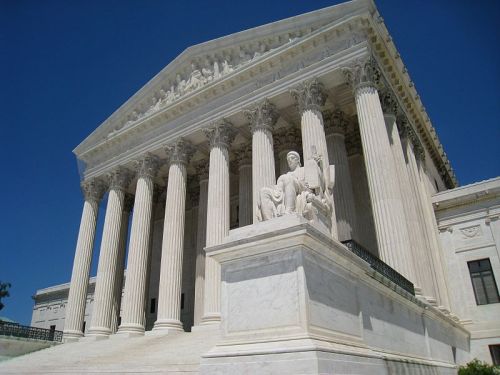
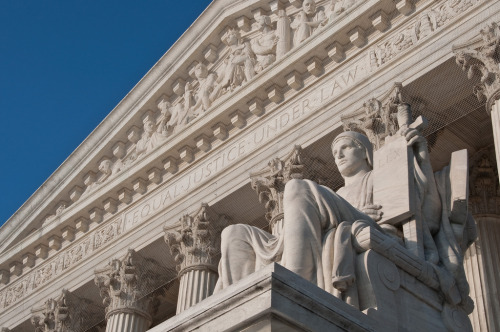
Supreme Court strikes blow against spreading menace of democracy

Supreme Court

The scourge of freedom is on the run!

Reuters: The U.S. Supreme Court on Wednesday expanded how much political donors can give candidates and parties in federal elections by striking down a key pillar of campaign finance law.

On a 5-4 vote, the court struck down the overall limits on how much individuals can give to candidates, parties and political action committees in total during the federal two-year election cycle.
Seriously, I don’t understand what the plebians are complaining about. After all, they have as much right to buy a politician as a Wall Street billionaire.

Blatant and shameless oligarchy, here we come…

[photo via Wikipedia Commons]

Friday, November 08, 2013

GOP’s election-rigging schemes can’t save them

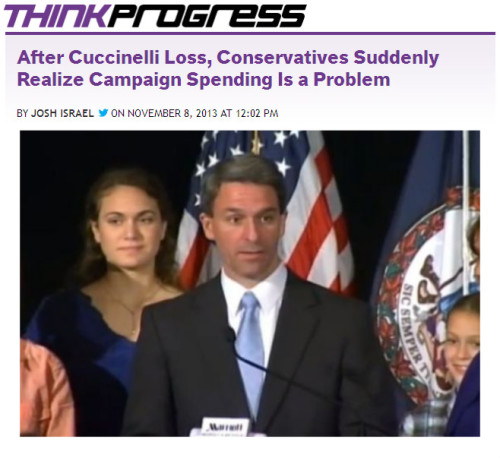
ThinkProgress - After Cuccinelli Loss, Conservatives Suddenly Realize Campaign Spending Is a Problem
ThinkProgress: Tuesday, as he conceded defeat in the Virginia governor’s race, Ken Cuccinelli II (R) told supporters that he had come closer than polls had indicated “despite being outspent by an unprecedented $15 million.” But while he and his conservative supporters now lament that money cost them the victory they felt they deserved, they have long been the defenders of the system of campaign finance non-regulation in Virginia and nationally.

Conservative groups like the Center for Competitive Politics have long argued that “money doesn’t buy elections.” Senate Minority Leader Mitch McConnell (R), whose own political action committee gave $5,000 to Cuccinelli’s campaign, has for years advocated for an end to limits on campaign contributions, believing “money is speech.” While the 2010 Citizens United ruling weakened federal contribution limits, Virginia has long been one of a handful of states with no limits whatsoever. The only restriction Cuccinelli supported over his time in the state senate was on contributions from foreign nationals.

Because of the Old Dominion’s anything goes system, candidates can accept millions of dollars from any individual or corporation seeking to ensure their victory. While Governor-Elect Terry McAuliffe raised over $32 million, Cuccinelli himself reported at least $19 million in donations — including hundreds of thousands from fossil fuel companies who preferred a climate-change denier to a candidate focused on green energy.
Business donors are now fleeing the GOP and Tea Party candidates like Cuccinelli in particular. A big part of the reason for this is the GOP’s obsession over debt and deficits to the detriment of the economy and jobs. The Democratic Party is now friendlier to business than Republicans — a position they find themselves in by default, as the GOP abandons anything resembling fiscal realism.

So the Americans United decision isn’t saving them and their voter suppression schemes aren’t saving them. It seems the only way Republicans have to stop losing elections is to stop trying to tell voters what to think and instead, listen to what voters have to say. They’re not going to like what they hear, but sucks to be them.

Of course, another option would be to push for legislation allowing gun owners to use their Glorious Second Amendment Freedoms to walk into polling places and force everyone to vote GOP at gunpoint. And I wouldn’t put it passed them, because the other ways they’re trying to rig elections just aren’t working.

Monday, August 12, 2013

Tea Party nutjobs are Republican Party’s own worst enemy

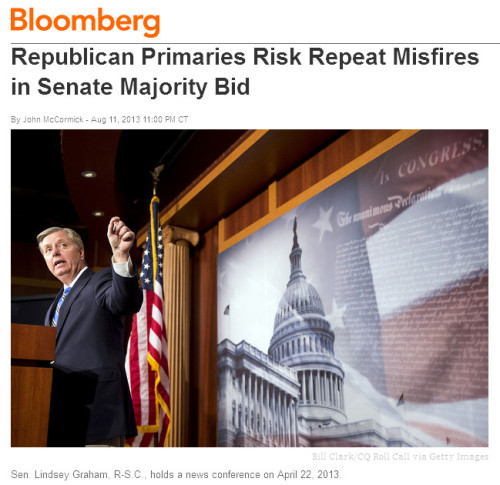
Bloomberg News - Republican Primaries Risk Repeat Misfires in Senate Majority Bid
Bloomberg News: Kentucky, Wyoming and South Carolina should be easy wins for incumbent Republicans trying to regain the U.S. Senate majority in 2014.

Instead, the primary challenges they face threaten to drain resources, sharpen campaign trail rhetoric and build division for a party struggling to find its way after a demoralizing 2012 election.

In Georgia, the Republican primary is jammed with seven candidates, pitting one wing of the party against the other — as is the case in the other states. Meanwhile, Democrats are unifying behind one candidate.

The infighting has raised Democratic expectations that they can keep control of the chamber and perhaps capture seats in Republican-leaning states. They did that in Indiana and Missouri in 2012 against inexperienced candidates backed by the small-government Tea Party branch of the party.
More Todd Akins, more Christine O’Donnells, more Sharon Angles? Yeah, they’re probably coming. And if history is any indication, the Tea Party insistence on ideological purity could be expensive. “It’s those primary challenges that shot down the Republican effort to win the Senate in the last two elections,” David Redlawsk, a political science professor at Rutgers University in New Brunswick, New Jersey told Bloomberg. “The Tea Party brought in what turned out to be very weak candidates.”

What gets me is that teabaggers seem to have convinced themselves that they speak for America. And, being a group of people who embrace an evidence- and fact-free belief system, the fact that America rejects them time and again does nothing to disabuse them of this belief. When Todd Akin opened his mouth and said the most insane thing ever, he really did think the public would find it compelling. They don’t say these aggressively stupid things because they think people need to be convinced that they’re true, they say them because they think they’re the sorts of things “everybody knows.” So they say these things not because they’re incautious or can’t censor themselves, but because they have absolutely no idea what the American public will find offensive and/or jawdroppingly asinine.

And the beauty of it all is that the Tea Party is a monster of the GOP’s own creation. They taught these chumps the things that “everybody knows” and now they find themselves being dragged down by their idiocy and ignorance — the very idiocy and ignorance the party instilled in these ‘baggers in the first place.

You don’t often see pure poetic justice in the wild, so make sure to savor it.

Friday, August 02, 2013

Lindsey Graham gets credible Tea Party primary challenger

Post and Courier - Nancy Mace expected to challenge Sen. Lindsey Graham
Post and Courier: Nancy Mace, one of The Citadel’s first two female graduates, is expected to announce Saturday that she will challenge U.S. Sen. Lindsey Graham in next June’s GOP primary.

Mace has indicated she may run and said Thursday she will make her decision known Saturday morning at the Berkeley County GOP breakfast meeting in Goose Creek.

In a separate news release, the county party said Saturday’s meeting will include “a special guest with a huge announcement for the entire state.”

Mace would be the second official Republican challenger to Graham, who has more than $6.3 million in his campaign warchest but whose willingness to compromise with Democrats has angered some in the GOP base.

If Mace runs, she would be Graham’s second primary challenger. Upstate businessman Richard Cash already has announced that he’s in the race.
If you were around for the Citadel story, you’ll recall that conservatives weren’t exactly Mace’s friends. Now she’s Tea Party. Some people deal with bullying by fighting back, others escape by joining the bullies’ team, I guess.

Mace is being called a credible threat to Graham in the South Carolina primary — and she probably is. What’s not being said is that he’s probably also a shoe-in in the general. So if Republican voters do boot him, he can take the route of his old friend Joe Lieberman, found a “S. Carolina for Graham" party, and win the general as a third party candidate. Republicans would  almost certainly allow him to caucus with them, because the numbers in the Senate are so tight they can’t afford to lose any members. A Lieberman-style sore loser run would be nearly guaranteed to come without consequence.

Tuesday, May 28, 2013

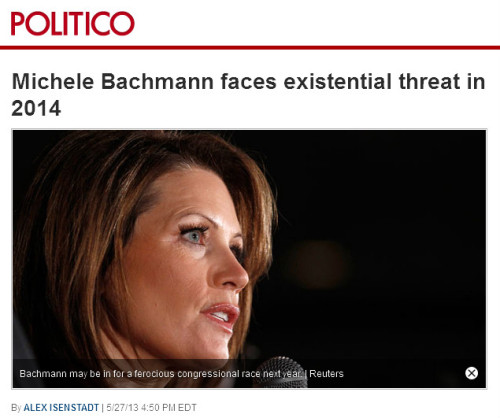
Is Bachmann facing her electoral doom?

Politico: Minnesota Rep. Michele Bachmann may be the congresswoman with nine lives. But 2014 could be the gravest threat to her political career yet.

The bomb-throwing conservative and onetime Republican presidential candidate is girding for what promises to be a ferocious reelection contest. Awaiting Bachmann is a serious Democratic opponent who has the full backing of his national party and a suburban Twin Cities electorate that six months ago nearly tossed her out of office.

The most glaring problem for Bachmann, though, may be a swirl of investigations into her campaign finances. The Federal Election Commission and the Office of Congressional Ethics are investigating whether her campaign concealed payments to an Iowa state senator who did work for her 2012 presidential bid. (A state ethics law bars senators from doing paid campaign work.)

And late last week, Minnpost.com reported that the FBI would be joining the investigation and interviewing a former Bachmann chief of staff.
It’s easy to dismiss Bachmann’s tough fight as a consequence of her legal and ethical troubles. But the fact is that Shelly barely won her race against hotel exec Jim Graves the last time around. Politico reminds us that Graves came “within 5,000 votes — 1.2 percentage points — of unseating her in 2012.”

Like other Republican house seats, Bachmann’s is gerrymandered. And that barely made the difference last time. This time, probably not. It’s the old demographics problem coming back again — Bachmann positively repels anyone other than GOP base voters and they’re becoming more and more of a minority as time goes on. Even without her scandals, Bachmann would likely do even worse this cycle, regardless of how conservative-leaning her district is drawn.

At a certain point, even electoral shenanigans will not save the GOP as a whole, as it may not save Michele Bachmann now. The influence of the Dreaded Progressive Menace is creeping into even the reddest districts and very little, if anything, can be done to stop it.

It’s time for Bachmann and her party to adapt or die. Unfortunately for them, that’s the process of evolution and they don’t believe in that.

Thursday, April 18, 2013

Why the background check ‘victory’ should taste like ashes to the GOP

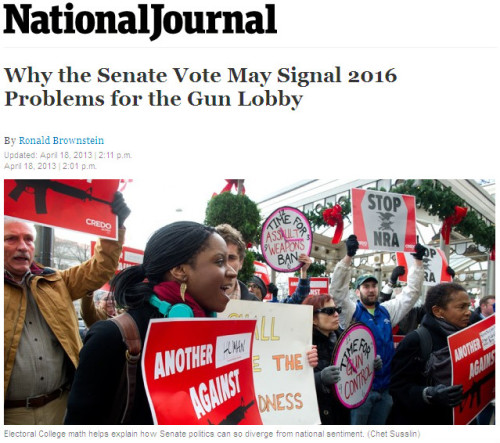
National Journal: The outcome of Wednesday’s dramatic Senate vote on expanding background checks simultaneously demonstrated the difficult geography confronting gun control advocates in the Senate and the potentially daunting math facing gun rights proponents in the Electoral College.

On the one hand, the defeat showed how difficult it is for gun control advocates to reach the 60 vote threshold required to break a filibuster in an institution whose two-Senator per state apportionment magnifies the impact of small, heavily rural states where guns are interwoven into the culture.

On the other, the vote suggested that, after years in which gun control has been sublimated as a political issue, support for expanding background checks and possibly further steps has again become a political norm in almost all of the blue-leaning states that underpin the recent Democratic advantage in the race for the White House.
In other words, the demographics of the Senate are very, very different from the demographics of the nation. What Republicans can win in the Senate is not necessarily an indication of the mood of the nation. In fact, the popular opinion landscape is even worse for Republicans than you might assume, since even with the outsized power of smaller states, the soft-on-crime side lost the vote — background checks would’ve passed with a 54 vote majority if it weren’t for the filibuster.

Newsflash: you don’t get to filibuster the 2016 elections. They’re walking into a clear loser here.

This morning, I wrote that Republicans would “be wise to ask themselves how many of these sorts of ‘victories’ their party can actually survive.” The electoral math is one more reason why they should slow down, take a deep breath, and consider whether this kind of “winning” is actually worth all the self-inflicted damage.

Monday, March 25, 2013

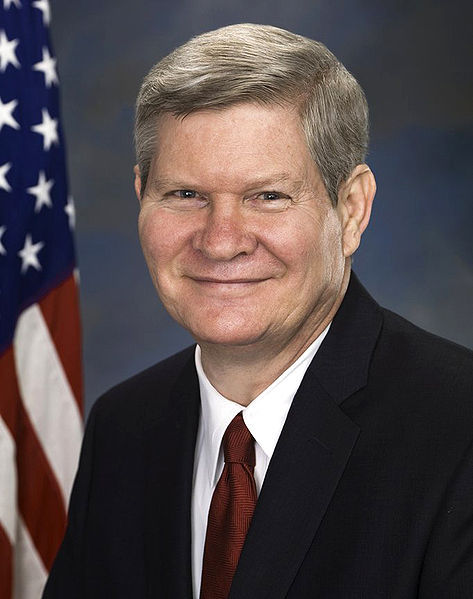
SD dem Sen. Tim Johnson retiring

Political Wire:

Sources tell Reuters that Sen. Tim Johnson (D-SD) does not plan to run for re-election when his current term ends in 2014.

Electoral-Vote.com rates Johnson’s seat as “strongly Democratic” — although that could obviously change. Right now that rating is based on polling of Johnson v. generic Republican. The GOP will be eager to pick up the seat, since 2014 probably represents the party’s last chance for a Senate majority for quite a while, if they can manage it at all.

You might remember a time when Johnson was much more pivotal to Republican hopes in the Senate. In December of 2006, Sen. Johnson suffered a severe stroke. Rightwing vultures circled, hoping he wouldn’t make it. South Dakota’s governor was Republican and Democrats had a one seat majority. Had Gov. Michael Rounds been able to appoint a Senator, control of the Senate would switch and the political landscape would’ve changed drastically. Without Johnson holding his seat, the damage done by the presidency of George W. Bush would likely have been much worse.

Friday, March 22, 2013

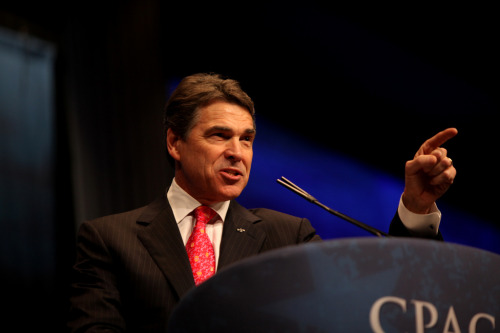
Is Rick Perry turning Texas blue?

National Journal:

Big in all things, Texas leads the nation in failing to provide health insurance. About one in four Texans are uninsured, the highest percentage in any state. That’s some 6 million people, the total population of Missouri.

Yet Gov. Rick Perry, back from his stumbles in the 2012 GOP presidential race, has insisted that Texas will not accept the federal money provided by President Obama’s health care law to expand Medicaid coverage. As Republican governors from Arizona to New Jersey have joined the program, Perry has amplified his opposition. In a bristling speech to conservatives last week, he said governors who accepted the money had “folded in the face of federal bribery.”

[…]

Rejecting the federal money might not pose an immediate political threat to Texas Republicans, whose coalition revolves around white voters responsive to small-government arguments. But renouncing the money represents an enormous gamble for Republicans with the growing Hispanic community, which is expected to approach one-third of the state’s eligible voters in 2016. Hispanics would benefit most from expansion because they constitute 60 percent of the state’s uninsured. A jaw-dropping 3.6 million Texas Hispanics lack insurance.

Texas Democrats are too weak to much affect the Medicaid debate. But if state Republicans reject federal money that could insure 1 million or more Hispanics, they could provide Democrats with an unprecedented opportunity to energize those voters—the key to the party’s long-term revival. With rejection, says Democratic state Rep. Rafael Anchia of Dallas, Republicans “would dig themselves into an even deeper hole with the Hispanic community.”

Keep in mind that Perry’s been very cautious about not alienating Latino voters. After all, this was the man who was practically booed off the stage at a presidential debate for saying that the children of undocumented immigrants deserve higher education and that a border fence was not a realistic option. Perry was not only ready, but eager to toe the very fringiest wingnut notions to win the nomination — except when they might scare off Texas Latinos.

So the danger presented in this article is obviously very real. And Perry’s been able to walk a tightrope between what wingnuts want and what won’t engage Latino voters against himself or his party. But walking a tightrope is hard and sooner or later, you’re going to mess up — especially when people are tugging at you from both sides.

If this turns out not to be the trigger of the big Texas turnover, it could be a contributing factor. That turnover is coming. That rightwing extremists and Latino voters will cross paths is almost inevitable. And that day is the day when Republican dreams of the White House officially die.

[photo via Gage Skidmore]

Thursday, March 21, 2013

Actual prospects for RNC’s blueprint for change pretty dim

longtime political analyst Stuart Rothenberg looks at the republican National Convention’s manifesto for change and sees one big, huge, obvious problem — someone actually has to do this stuff and rank and file Republicans simply aren’t interested.

While many of the suggestions contained in the Growth & Opportunity Project report would improve the party’s prospects, the nature of our political system makes it difficult for the RNC to remake the party, as former RNC Chairman Ray Bliss did in the mid-1960s, after Barry Goldwater’s defeat.

The RNC can improve its prospects by reaching out to Hispanics, Asian-Americans and younger voters. It can increase its relevance by emphasizing voter registration, micro-targeting and data collection, and by trying to woo college students and those becoming U.S. citizens. And it can promote young women and people of color to change the perception of the Republican Party primarily as the party of old white guys.

But while the report proposes a big tent strategy, others in the party — Rush Limbaugh, the Club for Growth, Sean Hannity, Tea Party Express and Jim DeMint — have a different agenda. Bliss did not have to deal with similar non-party groups 50 years ago, and their existence today undercuts the authority of the national party.

Allies of Ron Paul and “movement conservatives” have already criticized the RNC report, portraying it as little more than the establishment’s attempt to remake the party in the image of the Democratic Party.

It’s like the old joke: how many psychiatrists does it take to change a lightbulb? One, but the lightbulb has to want to change.

This particular lightbulb has no interest in changing.

So we have a party at war with itself. One side wants to be competitive in all elections, one’s only interested in winning the one they’re competing in, and yet another are just media blowhards interested in selling victimhood to the base. In other words, one side is right, but no one else actually cares.

[photo via Wikimedia Commons]

Tuesday, March 05, 2013

Republican politicians assume everyone’s as crazy as they are

Huffington Post:

Politicians, especially conservative ones, massively overestimate the conservatism of their constituents on the issues of gay marriage and universal health care, an academic paper published Sunday has found.

David E. Broockman of the University of California at Berkeley and Christopher Skovron of the University of Michigan surveyed nearly 2,000 state legislative candidates in the 2012 election and asked them what percentage of their constituents they thought supported same-sex marriage, a universal health care system and abolishing all welfare programs.

The result was a vast conservative misperception. Constituents, on average, supported gay marriage and universal health care by 10 percentage points more than their politicians had estimated. For conservative politicians, the spread was around 20 percentage points, meaning that conservative legislators tend to greatly overestimate how conservative their constituents actually are.

“For perspective, 20 percentage points is roughly the difference in partisanship between California and Alabama,” the authors write. “Most politicians appear to believe they are representing constituents who are considerably different than their actual constituents.”

To make matters worse, they seem to believe this despite all evidence to the contrary; look at all the shock GOPers when they found out that Mitt Romney lost or the continuing belief that voters will eventually blame Pres. Obama for the sequester. They literally do not know what voters in the real world are thinking.

This also explains why Republicans find it so easy to say the most insane things. Todd Akin could’ve just as easily began his weird rape-theorizing with, “As everyone knows…”

Of course, none of this is especially new. I’ve been pointing out for years that conservatives believe whatever the hell it is they want to believe — and reality be damned. I mean, how many times do we need to see polling that shows “even registered republicans think…” or “even NRA members believe…” before it becomes the most obvious thing in the world? But it’s always nice to have these things confirmed empirically.

It may seem like the study shows that liberals and conservatives make the same mistake, but nothing could be further from the truth: liberals and conservatives make the exact opposite mistake in judging the conservatism of their constituents. Liberals err on the side of caution, while conservatives see their constituents through rose-colored glasses. And, of course, the righties are twice as far removed from reality.

But still, there’s valuable insight for lefties here. “For liberal politicians, they appear to have more freedom than they may have initially perceived to act on issues such as gay marriage and health care,” the report tells us. “But the perception that constituents’ wishes are more limited means that a politician may think that 60 percent of constituents need to agree before moving forward with a policy, hence, the idea of a universal health care system is often seen as out-of-reach, though it may not be.”

In other words, political courage from the left stands a good chance of paying off. Especially when your election opponent thinks everyone listens to Sean Hannity.

Monday, February 25, 2013

SCOTUS refuses to dismantle what little remains of US campaign finance laws

Associated Press:

The Supreme Court won’t hear an appeal of a decision upholding a century-old ban on corporate campaign contributions in federal elections.

The high court on Monday refused to hear an appeal from William P. Danielczyk Jr. and Eugene R. Biagi, who wanted the courts to say the ban violates corporations’ free-speech rights.

A federal judge agreed with them, but the 4th U.S. Court of Appeals in Richmond, Va., overturned that decision. The Supreme Court’s 2010 Citizens United decision struck down a prohibition against corporate spending on campaign activities by independent groups but left untouched the ban on direct contributions to candidates.

The judge said independent expenditures and direct contributions were both political speech, but the appeals court said they must be regulated differently.

The justices will not review that decision.

Thank goodness for small miracles. This decision won’t make things any better, because it leaves the law as it is. But it keeps things from getting any worse — and yes, this case proves that worse is still possible.

Thursday, December 27, 2012

Are voters to blame for the partisan divide?

Jonathan Bernstein:

Is the source of polarization simple demographics — in particular, the effects of where Democrats and Republicans live and how that affects congressional representation?

That’s the case that Nate Silver makes in an important post today about House districts, in which he demonstrates two things: There are far, far, fewer swing House districts now than  20 years ago, and that with the decline of split-ticket voting fewer House districts vote for the candidate from the minority party in that district. Moreover, he shows, as others have, that the effects of gerrymandering are relatively minor in producing now-common lopsided districts.

Silver doesn’t mention it, but the same thing is true at the state level, with fewer competitive states now than there had been. That’s important, because we see polarization in both the House and the Senate, so any explanation for partisanship in Congress shouldn’t rely very much only on House districting.

This makes a lot of sense, even from a historical perspective. If you consider that senators are elected in statewide races, it goes a long way toward explaining why the Senate has historically been a less partisan chamber than the House — most states, when you get right down to it, are purple states. In all but the reddest of red states or the bluest of blue states, there’s no sense in being an unrelenting partisan, since it won’t get you reelected.

But I am surprised to learn that gerrymandering has very little to do with this. It seems the most obvious culprit. I guess I have to go with media. A lot of districts have no liberal media whatsoever, so all people hear is the crazy-assed bullshit that doesn’t reflect reality at all.

Just an educated guess, but it’s the best explanation I can come up with.

Thursday, December 13, 2012

Gerrymandering works -- 90% of congress reelected despite record low approvals

USA Today:

Voters apparently really, really like their own member of Congress even though the institution as a whole gets low ratings.

A whopping 90% of the House members and 91% of the senators who ran for re-election this year were returned to office, according to an analysis by Bloomberg Government (known as BGOV). That tops the 2010 re-election rates for both chambers, which were 85% and 84% respectively.

Think of it this way: The approval rating for Congress as a whole tied a record-low of 10% this year in the Gallup Poll. But as the BGOV analysis shows, voters don't hold such lowly opinions about their own members of Congress and they sent their representatives and senators back to Washington.

This is despite the fact that Democrats got the most votes in congressional races. Had more districts been anything close to competitive demographically, we'd have a Democrat-controlled House of Representatives right now.

Wednesday, September 14, 2011

Stories to Watch: 9/14/11

Frost warning tonight. Nothing says "summer's going away" like a frost warning. Cover up your tomatoes, people. Now here's the news...


A Bloomberg poll finds that voters aren't very excited about Obama's jobs plan -- 51% are opposed, 41% supportive. Which is weird, because Gallup found people supporting it, 54% - 32%. Likewise, Reuters/Ipsos found that Obama got a little bump from his jobs speech and introduction of the plan. Looks like Bloomberg's results are being outvoted.


Democrats haven't been doing well in special elections. Does that spell trouble for President Obama? Nate Silver has bad news.


Louie Gohmert plays the politics of "you snooze, you lose."


The Pennsylvania GOP tries to game the electoral college to deny Obama a 2012 win.


Rick Perry's claim that he only got five grand from the company that makes HPV vaccine turns out to be mostly bullshit.


Compare and contrast: Ron Paul's vision of American healthcare vs. Barack Obama's.


It's shit like this, Obama: "According to the Financial Times, President Obama is going to propose cuts of 'several hundred billion dollars from Medicare and Medicaid,' when he presents his proposal for deficit reduction next Monday." It's a lot easier to win these fights when you don't start by agreeing that your opponent is right -- especially when they aren't.


Meanwhile, Blue Dogs continue to ignore the fact that they got their asses handed to them in 2010. This time, they're playing "adult" by siding with the GOP against Obama's jobs plan. Your path to electoral victory through Republicanism-lite was a huge failure, people. Deal with it.


Finally, here's a Republican solution to unemployment -- import big ol' Burmese pythons and fabulous wealth will follow. No, really.
Enhanced by Zemanta

Monday, November 01, 2010

Feingold Finishes Positive

Here ya go. Last Feingold ad of the season.


RUSS!!

Wednesday, October 20, 2010

Johnson's Non-Plan for the Middle Class and Workers

As I reported yesterday, a new St. Norbert's/WPR poll has Ron Johnson and Russ Feingold pretty much neck and neck in the final weeks of the election. Is Johnson starting to feel the heat? Here's video from an interview with the Green Bay Press-Gazette, in which Johnson explains his plan to help the middle class:


Yeah, it kind of turns out he doesn't actually have a plan to help the middle class and, if his stumbling answers are any indication, he really hasn't given the subject a lot of thought. Soon after giving this interview, the Press-Gazette -- not a liberal bastion by any means -- gives their endorsement to Feingold, citing Johnson's lack of real economic solutions:

Feingold's opponent, Oshkosh businessman and political newcomer Ron Johnson, also has voiced his support for spending controls and fiscal responsibility in Washington. His plan for righting the U.S. economy, however, comes across as one-note: establish a hard spending cap, reduce government interference and allow businesses to flourish.

These are principles with which we agree; however, Johnson seemed unable to further articulate his plan for job creation -- especially for the middle class -- during a recent meeting with the Green Bay Press-Gazette editorial board. Basic principles of restraint are one thing; a detailed proposal to spur job creation and get our economy moving is another.


All of a sudden, this whole thing is going in the wrong direction for Team Johnson. This isn't to say that Feingold's clearly winning, though. A push in the right direction would do a lot at this point.

Wednesday, October 13, 2010

New Feingold Ad

Russ Feingold has the best negative ads:


No scary music, no black and white pictures of his opponent scowling, no stentorian voice-for-radio narrator promising gloom and doom if you vote the wrong way. Just an argument, then a counterargument. Done. Neat, clean -- this is the way it should be done.

I've always believed that you can learn more from negative ads than positive ones, since the positive ones put the candidate in the least controversial light -- "I voted for schools, veterans, families, to reduce crime, etc." But this is only true if the ads are honest, which they almost never are. This one is. According to Brian Beutler of Talking Points Memo, the ad goes on the air today.

This sort of thing isn't cheap and Johnson's a multi-millionaire who's basically trying to buy the election. Send him a few bucks or sign up as a volunteer. If there's one Democrat in the US who deserves to stay in office, it's Russ.

Monday, September 27, 2010

Obama: GOP Pledge "Not a Serious Approach"

President Obama takes a swing at the GOP's "Pledge to America." With a bat.

CNN:

President Barack Obama is responding to the GOP's so-called "pledge to America," saying the newly unveiled 21-page document is nothing more than a continuation of "irresponsible policies."

"What I'm seeing out of the Republican leadership over the last several years has been a set of policies that are just irresponsible. And we saw in their 'Pledge to America' a similar set of irresponsible policies," he told NBC's Matt Lauer Monday morning.

"They propose $4 trillion worth of tax cuts and $16 billion in spending cuts and they say we're going to somehow magically balance the budget," the president continued. "That's not a serious approach. So the question for voters over the next five weeks is who is putting forward policies that have a chance to move our country forward."


Things aren't going so well for the "pledge." As I posted yesterday, the DNC pointed out that they've already broken it and now FactCheck.org finds that it's riddled with bullshit claims. It's likely that Republicans are going to have to come up with honest-to-goodness real ideas soon and it's clear they've got nothing. They may be starting next year already up a creek without a paddle and I don't see any way that this can work out for them in the long run.

Sunday, September 26, 2010

GOP Break Their "Pledge"

Someone in the Democratic Party still has some brains. As evidence, I give you this video from the Democratic rapid response effort on the GOP and their pledge.


That "We're not going to be any different from what we've been" line is really getting a lot of play lately. And it should, it's an extremely odd thing to say. Polling shows that Republicans are actually pretty unpopular and the only thing giving them an edge is the enthusiasm of Republican voters. What you really want to be doing now is giving Democrats and Independents a reason to stay home on election day, yet here Boehner is, basically saying, "We're going to keep being the dicks you don't like." You really have to wonder what the orange man was thinking.

In the end, it may be that the comment hurts the GOP more than the hypocrisy here. We'll have to see how it plays out.

While we're on the subject of Boehner, check out Tanya Somanader's post at Think Progress. Shorter version: Boehner admits the "pledge" offers no real solutions. Is he becoming gaffe-prone or was he always?

Friday, September 24, 2010

Boneheaded Dem Move had Boneheaded Reason

Facepalm
Why did Democrats decide to pass up a golden opportunity and put off ending Bush's tax giveaway for the wealthy until after the elections? Greg Sargent spoke to some people and found that, while what he calls "politically savvy" dems wanted to go ahead with a sure winner, the fact that it was a sure winner is what sank a pre-election vote.

So why did it fail? According to a very plugged in Senate aide, Senators debating the issue were very aware that the polling was on their side. Yet, paradoxically, this ended up tipping the balance against holding the vote. Senate Dems felt they were already winning on the issue, and in the end they thought a vote risked upsetting a dynamic that was already playing in their favor.

"People felt like, Why rock the boat on a good situation?" the aide tells me. "People weren't sure how how having a vote would effect that dynamic. We would have lost Democrats on certain aspects of the vote. Who knows if the media would cover that as Democrats being splintered? In a way the good polling gave people faith that we dont need to do anything on the issue because we're already winning."


Let me amplify that a little: in the end, Democrats felt the vote was unnecessary because everything is going so well.

If this were a boxing match, I'd be worried that the guy in the blue trunks was taking a dive. But the fact is that, while their policy ideas are better, Democrats just suck at this partisan politics stuff. A lot.

A whole lot.

Search Archive:

Custom Search