THE LATEST
« »
Showing posts with label energy. Show all posts

Thursday, February 20, 2014

Study shows fossil fuels, nukes unnecessary to provide the world with energy

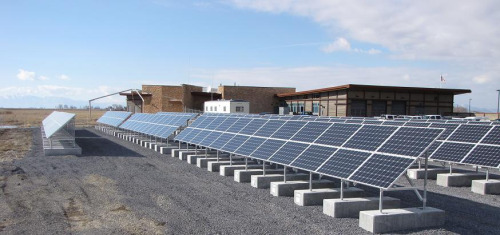
PhysOrg: New research has shown that it is possible and affordable for the world to achieve 100 percent renewable energy by 2030, if there is the political will to strive for this goal.

Achieving 100 percent renewable energy would mean the building of about four million 5 MW wind turbines, 1.7 billion 3 kW roof-mounted solar photovoltaic systems, and around 90,000 300 MW solar power plants.

Mark Delucchi, one of the authors of the report, which was published in the journal Energy Policy, said the researchers had aimed to show enough renewable energy is available and could be harnessed to meet demand indefinitely by 2030.

Delucchi and colleague Mark Jacobson left all fossil fuel sources of energy out of their calculations and concentrated only on wind, solar, waves and geothermal sources. Fossil fuels currently provide over 80 percent of the world’s energy supply. They also left out biomass, currently the most widely used renewable energy source, because of concerns about pollution and land-use issues. Their calculations also left out nuclear power generation, which currently supplies around six percent of the world’s electricity.
I wasn’t extremely surprised that we could get by without fossil fuels. What got my attention was that nuclear power was left out of the equation as well. A lot of people have been trying to paint nuclear as a necessary evil, saying we’d have to use “clean” nuclear power to reduce carbon emissions. This study proves them wrong.

Turns out we can power the whole planet without using energy from an industry that produces what may be the most dangerous toxic waste known to humanity. Good to know.

[photo via Wikimedia Commons]

Saturday, April 06, 2013

ExxonMobil oil spill results in ExxonMobil chemical spill

Grist:

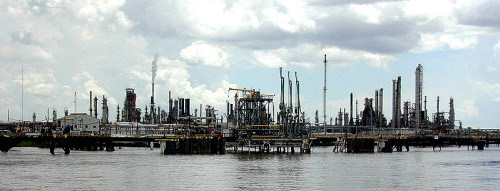
Even as ExxonMobil was mopping up after its disgusting tar-sands oil spill in Arkansas on Wednesday, it spilled an unknown amount of unknown chemicals — possibly hydrogen sulfide and cancer-causing benzene — during an accident at a riverfront refinery in Louisiana.

The Chalmette refinery chemical spill might have gone unnoticed, except that it stank out the city of New Orleans and several nearby parishes, leading to state and federal investigations (we told you about that mysterious odor yesterday). Frankly, ExxonMobil’s track record here sucks: The same refinery spilled 360 barrels of crude oil in January.
Keep in mind that this chemical spill would never have happened if it wasn’t for the oil spill. This means that each spill creates the possibility of related spills and that the Chalmette spill could conceivably result in yet another spill someplace else. In other words, we risk environmental disaster every time there’s an environmental disaster. Cleaning up catastrophe creates new possibilities for catastrophe.

Look, we’re going to have to quit using fossil fuels eventually. Since they’re finite resources, that’s a given. Likewise, as they get more and more scarce, supply and demand will keep jacking the price up. And, of course, the whole thing is dangerous and dirty.

Add all those facts together and it’s hard to see how it’s not a good idea to start transitioning away from fossil fuels now. I mean in a meaningful way. In a deliberate way with the end of fossil fuels being the goal. We’ll save ourselves a lot of money in the long run and we’ll be doing the environment (and our health) a big favor, all by getting a head start on something we’ll have to do eventually anyway. We’ll create new jobs, new markets, and new technologies. We can start working on developing and perfecting alternative energy technology now or we can keep doing this stupid, dirty, pointless, and increasingly expensive stuff until it becomes impossible to continue and then switch over to alternatives.

Seems like a no-brainer to me. Unfortunately, there’s no shortage of people who seem to have no brains.

[photo via Wikimedia Commons]

Thursday, February 21, 2013

All new US generating capacity so far this year has been renewable

The Hill:

Renewable energy accounted for all new electric capacity added in the United States last month, according to the Federal Energy Regulatory Commission.

In all, 1,231 megawatts of new generating capacity were installed in January. Of that total, wind provided 958 megawatts, solar chipped in 267 megawatts and biomass contributed 6 megawatts.

That’s a marked difference from January 2012, when coal led the way with 808 megawatts of the 1,693 megawatts added. Natural gas followed with 445 megawatts, and wind tossed in 276 megawatts to take the pole for renewables.

On Wednesday, President Obama sought to expand promotion of renewable energy by reviving the Commerce Department’s Renewable Energy and Energy Efficiency Advisory Committee.

Weird, I’m not noticing the sky falling here. Looks like we can add a bunch of renewable generation without even noticing it. In fact, this is actually nothing new.

“The U.S. already doubled its electric generating capacity from renewable sources between 2008 and 2012, according to a Bloomberg New Energy Finance and Business Council for Sustainable Energy report released last month.”

You didn’t notice a thing. It was completely painless.

[image source]

Sunday, September 23, 2012

Not fighting global warming is really expensive

New York Times:

Jeff Rothschild’s machines at Facebook had a problem he knew he had to solve immediately. They were about to melt.

The company had been packing a 40-by-60-foot rental space here with racks of computer servers that were needed to store and process information from members’ accounts. The electricity pouring into the computers was overheating Ethernet sockets and other crucial components.

Thinking fast, Mr. Rothschild, the company’s engineering chief, took some employees on an expedition to buy every fan they could find — “We cleaned out all of the Walgreens in the area,” he said — to blast cool air at the equipment and prevent the Web site from going down.

That was in early 2006, when Facebook had a quaint 10 million or so users and the one main server site. Today, the information generated by nearly one billion people requires outsize versions of these facilities, called data centers, with rows and rows of servers spread over hundreds of thousands of square feet, and all with industrial cooling systems.

In a yearlong investigation into the energy usage by online companies, NYT found “the information industry is sharply at odds with its image of sleek efficiency and environmental friendliness.”

The problem seems to be one of sheer laziness: “Online companies typically run their facilities at maximum capacity around the clock, whatever the demand. As a result, data centers can waste 90 percent or more of the electricity they pull off the grid, The Times found.” Rather than monitor demand and adjust capacity accordingly — like a utility — data centers just run everything at full blast all the damned time.

And it’s here that the argument that reducing our dependency on fossil fuels means economic disaster dies. That’s why this argument is made mainly by energy producers — oil and coal companies, for example. If everyone cut back on energy usage, coal companies would make less money, sure. But everyone else would make more. If we put real effort — I’m talking Apollo project effort — into reducing energy consumption, we’d have energy for dirt cheap (not only because we use less, but because supply and demand would drop the price at the same time) and a cleaner environment. Meanwhile, all this new technology would give birth to entire new economic sectors.

New technologies, new industries, new markets — yup, sounds like a real economic nighmare, huh? Much better to keep shoveling coal and money into 20th century furnaces to keep the 21st century world running full-freakin’-throttle, 24-7 — whether we need it to or not.

Thursday, March 05, 2009

Griper Blade: Nuclear Power, a Guaranteed Money-Loser

Nuke cooling towers depicted as made out of moneyIt's become fashionable lately to tack the words "safe and clean" before the words "nuclear energy." It's hard to understand how an industry that creates waste so toxic it has to be buried deep in the heart of a mountain can be described as safe or clean. You'd think a better description would be "dangerous and poisonous."

But one word that's never used in connection with nuclear power is "cheap" and it may be that the best kept secret regarding nuclear generation is that it costs taxpayers a huge amount of money. In fact, nuclear power is practically guaranteed to be a money loser -- Wall Street won't finance plants -- and it's almost inevitable that every new generation facility will require an infusion of federal money at some point.

According to the Union of Concerned Scientists (UCS), "Originally conceived as providing power that would be 'too cheap to meter,' nuclear energy was seen as the future of the electric industry. Reality quickly overtook this utopian vision in what has been called 'the largest managerial disaster in business history,' leading to two bailouts of the industry in the 1980s and 1990s."

In fact, UCS warns that, if we go ahead and expand nuclear power generation to the extent that the industry wants, we'll wind up bailing them out to the possible tune of more than a trillion dollars... [CLICK TO READ FULL POST]

Tuesday, February 24, 2009

Griper Blade: Bush's Loose Nukes

Cooling towers at nuclear plantGeorge W. Bush has no plans to retire any time soon. A post at Think Progress reminds us that Bush plans to make "ridiculous" amounts of money on the speaking circuit. While he'd probably be more valuable as a frank and honest witness to his own incompetence, criminality, and hubris, this is George W. Bush we're talking about here. Bush doesn't plan any truth-telling tours, putting all his mistakes on display so we can all learn from them. Former president Bush plans to be exactly like then-president Bush -- three gallons of smart in a fifty gallon drum, with BS making up the difference.

What people will spend the big money to hear will be Baron George Von Munchausen spinning tall tales of his own greatness. That is, if his bio at his agency -- Washington Speakers Bureau -- is any indication:

President George W. Bush served in the Oval Office for eight of the most consequential years in American history. Faced with challenges from a terrorist attack to a global financial crisis, he made difficult decisions that will shape the nation’s course and world affairs for decades to come. His leadership after the terrorist attacks of September 11, 2001, was an inspiration to millions of Americans. His policies, while controversial at times, kept the country safe for more than seven years and liberated more than 50 million people from tyranny.


Say what you like about President George, but he kept us safe -- that is, if you start counting right after the most deadly terrorist attack in American history. If you throw 9/11 into the mix, Bush averages more than one terrorist murder on American soil for every day of his presidency. In the "keeping us safe" category, Bush sucked just as badly as he did at everything else... [CLICK TO READ FULL POST]

Tuesday, August 19, 2008

Offshore Energy That Doesn't Require Drilling

clipped from www.mcclatchydc.com

Picture 400 super-size windmills spinning in a steady, stiff ocean breeze miles off the coasts of California, New England, the mid-Atlantic, Washington state, the Great Lakes and the Gulf of Mexico.


Even as Congress is embroiled in a sharp debate over whether to allow increased offshore oil and gas drilling, others are seriously working to develop a green source of energy along the outer continental shelf.

The winds blowing 15 miles or even farther off the U.S. coasts potentially could produce 900,000 megawatts of electricity, or roughly the same amount as nearly all the nation's existing power sources combined, according to Department of Energy estimates.

"This is a slam dunk," said George Hart, chief technical officer at the Ocean Energy Institute, a Maine-based research center. "None of this is high-tech. It can be done."

I had no idea that there was that much energy blowing around out there. 900,000 megawatts is a freakin' huge amount of generating capacity.

Sunday, August 17, 2008

Two Large Solar Projects Planned for California

clipped from www.nytimes.com

Companies will build two solar power plants in California that together will put out more than 12 times as much electricity as the largest such plant today, the latest indication that solar energy is starting to achieve significant scale.

The plants will cover 12.5 square miles of central California with solar panels, and in the middle of a sunny day will generate about 800 megawatts of power, roughly equal to the size of a large coal-burning power plant or a small nuclear plant. A megawatt is enough power to run a large Wal-Mart store.

At 800 megawatts total, the new plants will greatly exceed the scale of previous solar installations. The largest photovoltaic installation in the United States, 14 megawatts, is at Nellis Air Force Base in Nevada, using SunPower panels.

While I'm not extremely keen on these sort of plants -- there's no real reason to centralize solar generation like this -- it's nice to see that solar's being taken seriously. Given recent advances in photovoltaic technology, the price is coming down enough for it to be put anywhere the sun shines. In other words, there's no reason to use up huge expanses of land when you can do the same thing on rooftops.

Still, any time new generating capacity comes from green tech, it's good news.

Friday, August 01, 2008

Griper Blade: Corporate Commies

This is how bad the economy is. Once again, Exxon sets the record for profit this quarter -- $11.7 billion. More than any company has ever earned in history. This is bad news for the oil giant, since they didn't do as well as predicted. So, despite making just giant wheelbarrows full of cash, Exxon closed 3% down on the news. Boy, talk about an undervalued stock -- no one's losing money here.

One reason that Exxon didn't do as well as expected is a decrease in production. And that's why we've got to drill, drill, drill. Got to pump up that production. We need oil... Dear Sweet Jesus, we need oil!

But that urgency isn't really reflected in oil companies' spending practices. While we're told that corporations like Exxon are desperate for oil, they sure as hell aren't acting like it.

Associated Press:

The companies insist they’re trying to find new oil that might help bring down gas prices, but the money they spend on exploration is nothing compared with what they spend on stock buybacks and dividends.

It’s good news for shareholders, including mutual funds and retirement plans for millions of Americans, but no help to drivers already making drastic cutbacks to offset the high cost of fuel.

The five biggest international oil companies plowed about 55 percent of the cash they made from their businesses into stock buybacks and dividends last year, up from 30 percent in 2000 and just 1 percent in 1993, according to Rice University’s James A. Baker III Institute for Public Policy.

The percentage they spend to find new deposits of fossil fuels has remained flat for years, in the mid-single digits.


It strikes me that spending less than 10% on oil exploration doesn't do a lot to increase production.

But that's OK. Oil companies don't need to find oil, they know where some is -- where they're not allowed to drill. The reason they can't find oil anywhere other than offshore and in the Arctic National Wildlife Refuge is because they haven't actually been looking...

[CLICK TO READ FULL POST]

Wednesday, July 23, 2008

Big Oil Spends $ on Shareholders, not Exploration

clipped from www.courant.com

The five biggest international oil companies plowed about 55 percent of the cash they made from their businesses into stock buybacks and dividends last year, up from 30 percent in 2000 and just 1 percent in 1993, according to Rice University's James A. Baker III Institute for Public Policy.


The percentage they spend to find new deposits of fossil fuels has remained flat for years, in the mid-single digits.

In the first three months of this year, Exxon Mobil Corp., the world's biggest publicly traded oil company, shelled out $8.8 billion on stock buybacks alone, compared with $5.5 billion on exploration and other capital projects.

ConocoPhillips has already told investors that its stock buybacks for April to June of this year will come to about $2.5 billion — nine times what it spent on exploration.
"If you're not spending your money finding and developing new oil, then there's no new oil," said Amy Myers Jaffe, an energy expert at Rice University
If the price of oil is really a supply-and-demand problem, as the Bush admin. asserts, then Big Oil isn't doing much to increase the supply.

Saturday, July 19, 2008

Gore Compares Offshore Drilling to Iraq

clipped from www.politico.com
In a surprise appearance at Netroots Nation — which apparently was the worst-kept secret in Austin, Texas — former Vice President Al Gore followed up a speech by Nancy Pelosi by laying out a narrative on climate change and the energy crisis that seems ready-made for the Obama campaign to download.

“The defenders of the status quo are the ones who have dug us into this hole,” he said, commenting that Americans have been “so often fooled into finding a remedy for a problem" that has nothing to do with the problem at hand — pointing to the invasion of Iraq when America was attacked by terrorists in Afghanistan as an example.


“The engines of distraction and the great concentrated power of communication that you’ve seen turned on this issue or that issue is already hard at work," he says. "They will say we can’t switch away from oil."
Holy crap, has Gore been reading my blog?

Windows as Solar Panels Within 3 Years

clipped from www.enn.com

MIT researchers have announced
that they have created “organic solar concentrators” that could make
windows become powerful solar panels in as little as three years.

The
concentrator is mixture of two or more dyes painted onto a pane of
glass or plastic. The dyes absorb light across a range of wavelengths,
re-emit it at a different wavelength and transport it across the pane
to the solar cells at the edges. Focusing the light like this increases
the electrical power generated by each solar cell by a factor of 40.

The
advantages are twofold: the dyes greatly increase the power of solar
cells, and homeowner are much more likely to incorporate solar glass
into their homes.
Man, do I ever like this. It's one step closer to putting solar everywhere.

Friday, July 18, 2008

Griper Blade: One Foot in the Grave

Yesterday, I wrote about a campaign of BS by the right that may rival the propaganda campaign that led us into Iraq. The goal of that campaign is offshore drilling. Almost nothing that's being said by the right has been true -- offshore drilling isn't environmentally safe, China's not already drilling off Cuba, and it won't bring down gas prices.

When I write a post, I often collect more information than I actually need, which means that some examples aren't used in the posts. Usually, these unused stories turn out to be too insane to be representative. It may be tempting to compare some antigay dumbass to Fred Phelps, for example, but it may not be apt. It's kind of like comparing any old right wing zombie to Hitler -- I guess I believe that Godwin's law should be expanded. Similarities are not equations; bad may be bad, but there are degrees of bad, just as there are degrees of BS.

I bring this up to introduce you to a particular group of phonies known as the Congress of Racial Equality (CORE).

Right Wing Watch:

A gathering led by Niger Innis of the Congress of Racial Equality, Bishop Harry Jackson of the High Impact Leadership Coalition, and the new group Americans for American Energy held a press conference yesterday demanding increased “American Energy” production. Their contentions were twofold: that high energy costs disproportionately harm low-income families, and that increased domestic oil drilling would solve the problem. Standing in the way: the “elitist Volvo-driving” environmentalists. Watch:


Although CORE was once a prominent civil rights group, after Niger Innis’s father, Roy, took control in 1968, he led it to the far right, honoring Karl Rove at its Martin Luther King dinner, backing extreme Bush judges, and defending oil companies. According to a Mother Jones article, “Innis has been accused by founder James Farmer and other black leaders of renting out CORE’s historic reputation to corporations like Monsanto and ExxonMobil. (CORE even mounted a counterprotest to environmentalists picketing an ExxonMobil shareholders’ meeting.)”


There's a war on the poor -- by environmentalists. Really? Seems to me that enmity of the poor is a cornerstone of modern Republicanism. After all, it's been the right wing's love of deregulation and hatred of corporate accountability that's screwed the economy. No one's losing their home because some environmentalist is foreclosing on them...

[CLICK TO READ FULL POST]

Tuesday, July 08, 2008

Obama Ad Hits Back on Energy

clipped from my.barackobama.com

The Obama Campaign today released a new ad which sets the record straight on energy policy and responds to false, negative attacks by John McCain and the Republican party. 

The 30-second spot, “New Energy,” highlights Senator Obama’s plan to make us energy independent and bring relief to middle class families, compared to John McCain’s plan to continue George Bush’s failed energy policy and offer more tax breaks to big oil.  The ad will run in Michigan, Ohio, Pennsylvania and Wisconsin – the same four states in which the Republican National Committee is running false, negative ads attacking Barack Obama.
This is the Obama campaign striking back against a McCain ad that paints him as having no energy solutions.

Meanwhile, McCain's energy plan is a gas tax holiday and drilling -- "drill more, burn more" isn't going to accomplish anything.

Tuesday, July 01, 2008

World Enjoying a 'Green Energy Gold Rush'

clipped from www.afp.com

The world is enjoying a "green energy gold rush", the UN's environmental agency said Tuesday as it published a report outlining a 60 percent hike in investment in renewable energy in 2007.

The UN Environment Programme (UNEP) study, published in Nairobi, said more than 148 billion dollars (93 billion euros) of new funds were ploughed into the quest for cleaner energy last year.

"Just as thousands were drawn to California and the Klondike in the late 1800s, the green energy gold rush is attracting legions of modern-day prospectors in all parts of the globe," UNEP Executive Director Achim Steiner said in a statement.

"What is unfolding is nothing less than a fundamental transformation of the world's energy infrastructure."

It turns out that it's "green" as in "environmental" and "green" as in the color of money.

Thar's gold in them thar solar panels...

Thursday, June 26, 2008

Griper Blade: Climate and Energy for Dummies and Fascists

Writing for The Nation, Mark Hertsgaard assures us that "the United States is finally going to have a President who takes climate change seriously enough to do something about it." Does he have the inside scoop on who's going to win?

No. His argument is that both Obama and McCain have said that climate issues will be a top priority for their administrations. Hertsgaard points out that McCain's environmentalism is much weaker than Obama's -- pointing, as I have, to McCain's ludicrous misrepresentation of "cap and trade." But a weak enviro president is better than what we have. Bush seems to actually hate the environment. He's certainly doing what he can to punish it.

Things that absolutely must be done -- like a global end to coal burning -- seem completely beyond McCain, who's environmentalism is restricted by his position in the corporate pocket.

Of course, a new report may change the Republican outlook on environmental issues. The police state party can now look at global warming as a security issue.

Washington Post:

U.S. intelligence agencies have concluded that global climate change will worsen food shortages and disease exposure in sub-Saharan Africa over the next two decades, creating operational problems for the Pentagon's newest overseas military command.

"Without food aid, the region will likely face higher levels of instability, particularly violent ethnic clashes over land ownership," probably creating "extensive and novel operational requirements," for the fledgling U.S. Africa Command, according to a National Intelligence Assessment on the security implications of climate change by the National Intelligence Council...


[CLICK TO READ FULL POST]

Tuesday, June 24, 2008

Griper Blade: Two Proposals, One Solution

Mcain and GrammSometimes, you see two headlines and they sum up an issue nicely. Especially when the subjects of both headlines are two presidential candidates' solutions to roughly the same problem. I had this experience looking through Reuter's headlines yesterday. The two headlines are "McCain calls for $300 million prize for car battery" and "Obama vows to crack down on oil speculation."

The McCain headline deals with McCain's approach to oil prices and energy problems. Like his offshore drilling idea, McCain's non-existent battery might possible pay off within ten years. With gas prices rising as quickly as they are, in ten years it might be cheaper to buy a car that runs on diamonds. Unless an immediate problem can be addressed by sending in more troops, John McCain doesn't seem to have any idea what to do about it.

Republican John McCain said on Monday if elected he would propose awarding a $300 million prize to the auto company that develops a next-generation car battery that weans America off oil.

McCain sought to portray himself as a forward-looking leader on solving the U.S. energy crisis a week after taking heat from Democrats for reversing position and supporting offshore oil drilling.

"Whether it takes a meeting with automakers during my first month in office, or my signature on an act of Congress, we will meet the goal of a swift conversion of American vehicles away from oil," McCain told a town hall meeting in Fresno, in rural central California.


And this addresses oil prices how? McCain is basically saying, "I've got no idea what to do. Here's a buttload of money, can I buy an idea?"...

[CLICK TO READ FULL POST]

Friday, May 23, 2008

Griper Blade: A Thimble-Full of Nuthin'

Arctic National Wildlife Refuge
By far the most promising site for oil in America is the Arctic National Wildlife Refuge in Alaska. Technology now makes it possible to reach the oil reserves in ANWR by drilling on just 2,000 of the 19 million acres. Developing this tiny area could eventually yield up to a million barrels of oil every day -- and that million barrels of oil a day would be -- would make us less dependent on foreign sources of energy. Thanks to technology, we can reach ANWR's oil with almost no impact on the land or local wildlife. To make America less dependent, Congress needs to pass a pro-growth, pro-jobs, pro-environment development of ANWR. It makes sense. It is an important part of a comprehensive strategy.
--George W. Bush, "President Discusses Energy Policy," 2005


Why are gas prices so high? If you ask George W. Bush, he'll tell you it's Congress's fault. "One of the main reasons for high gas prices is that global oil production is not keeping up with growing demand,” Bush said last month. “Members of Congress have been vocal about foreign governments increasing their oil production, yet Congress has been just as vocal in opposition to efforts to expand our production here at home."

Bush's solution was what Bush's solution always is -- drill in Alaska’s Arctic National Wildlife Refuge (ANWR). According to him, this would "likely mean lower gas prices."

The Washington Post called this a return to "first-term answers to rising gas prices." Bush has always wanted to drill in ANWR, despite the fact that there's a thimble-full of oil up there. Drilling in Alaska has been like tax cuts for George W. Bush -- whatever the problem, it's the solution. When the economy's doing well, tax cuts are needed to keep it going. When the economy's doing poorly, tax cuts are needed to fix it. There is never a time when tax cuts -- especially the radically top-heavy cuts favored by Bush -- are not the answer to the problem.

So it's been with drilling in ANWR. When we're too dependent on foreign oil, we need to drill in ANWR. When prices are too high, we have to drill in ANWR. If the weather report predicts patchy clouds, we have to drill in ANWR. No matter what the problem, the puddle of oil under the Alaskan wilderness is the answer...

[CLICK TO READ FULL POST]

Wednesday, April 30, 2008

Griper Blade: You've Been Robbed

Call it a parallel to George W. Bush's energy policies:

Associated Press:

A choir director who hopes prayer can bring down high gas prices is trying out his approach at some of the costliest pumps in the country.

Rocky Twyman of Washington, D.C., came to San Francisco over the weekend to stage a pray-in at a Chevron station. He is also calling on churchgoers to ask for God's intervention where he says politicians have failed.

Gas costing $4 a gallon or more has become common around the San Francisco Bay area.


For the record, I don't think that's going to work. Neither are any of Bush's ideas. The president's big idea on cutting gas prices is to drill in the Alaskan National Wildlife Refuge (ANWAR). The problems here are many. First and foremost, you've got to actually get the oil -- which involves laying roads, constructing buildings and rigs, finding the oil, pumping the oil, getting it to refineries, etc. You want immediate relief? This ain't it.

Second, there's about five minutes worth of oil up there. You've got to wonder if the oil used to get it will be worth the oil recovered. In 2004, Bush's own Energy Department determined that drilling in ANWAR would have almost no effect on prices...

[CLICK TO READ FULL POST]

Tuesday, January 29, 2008

Griper Blade: Eight Speeches, Zero Results

President Bush delivers the 2008 State of the Union


Bush gave his final State of the Union Address last night -- the operative word here is "final." As in, the American people rejoice and say, "Yay!" Last night, we saw the light at the end of the tunnel. It's still nearly a year away, but it's there. We see it. We know that our long national nightmare will end. We will wake. Personally, I plan on getting massively hammered after the next president is sworn in. New Years Eve blotto. If I can talk friends into stupid paper hats, noisemakers, and champagne, then that's what we'll do. Like every New Years Eve, when the next president takes the Oath of Office, we'll have every reason to celebrate a new beginning.

And the beauty here is that it really doesn't matter much who wins. I've always argued that a cinderblock would make a better president than Bush has, since a cinderblock can't actually do anything -- which means it can't do anything wrong. If there's going to be one thing the next president has to thank Bush for -- and it'll be the only thing -- it'll be for setting the bar of a successful presidency so damned low. If you do better than Bush, you'll be a tremendous success. Pretty much the only way to do a worse job will be to try. At both the Summer and Winter Olympics of Suck, President Bush is a Gold Medalist.

I decided I'd go through the past SOTU addresses and look at one issue -- energy. See, throughout his presidency, Bush has used every SOTU as an occasion to deliver empty rhetoric, push propaganda, and to make promises soon to be forgotten and broken. Some of the promises he made were easy -- in 2006, he promised to stop mad scientists from creating "human/animal hybrids." Since there was no Dr. Moreau out there making tiger women and baboon men, that was a pretty easy promise to keep...

[CLICK TO READ FULL POST]

Search Archive:

Custom Search