THE LATEST
« »
Showing posts with label privacy. Show all posts

Thursday, January 16, 2014

Was the aircraft in Feinstein’s drone story actually a drone at all?

The Wire - Was the Drone that Feinstein Encountered at Her House This Tiny Pink Helicopter?
The Wire: The Wire spoke by phone with Feinstein’s spokesman Brian Weiss, who confirmed that the incident happened at the senator’s house in San Francisco several months ago. At about the time, it seems, that Code Pink showed up to protest Feinstein’s support for the NSA.

On June 15, the anti-war group held a protest focused on Feinstein, which included activists in disguises and, yes, two remote-controlled helicopters, which might creatively be described as drones…
Steve Rhodes, who took [photos of the event], confirmed to The Wire that the helicopters flying around outside Feinstein’s home didn’t have any cameras, so they weren’t “looking in” anywhere.
If this is the incident that Feinstein was talking about, then the irony overwhelming. The little helicopters were no doubt meant to represent eye-in-the-sky drones that the NSA may or may not be (but probably are) using to spy on US citizens — and Feinstein supports the NSA’s domestic surveillance.

So, govenrment drones spying on Americans are cool. But pretend government drones not really spying on anyone? The worst thing ever!


Monday, August 12, 2013

Bloomberg’s response to ‘stop and frisk’ ruling: fearmongering and logical fallacies

Michael Bloomberg
I can sum up NYC Mayor Bloomberg’s response to a ruling effectively ending the city’s “stop and frisk” policy (it’s hard to see how any reform will be possible): “WE’RE ALL GONNA DIE!!!" He defends the racial profiling by saying, "They fight crime wherever crime is occurring, and they don’t worry if their work doesn’t match up to a census chart. As a result, today we have fewer guns, fewer shootings, and fewer homicides. In fact, murders are 50 percent below the level they were 12 years ago when we came into office – something no one thought possible back then."

The problem, of course, is that the racial component of “stop and frisk” is an abject failure and Bloomberg’s math doesn’t add up at all. During the trial which led to her ruling, Judge Shira Scheindlin noted that “A lot of people are being frisked or searched on suspicion of having a gun and nobody has a gun.” In fact, only 0.14% of these searches turned up a gun or contraband, “So the point is suspicion turns out to be wrong in most cases.” Worse, some 80% of those subjected to “stop and frisk” were minorities. So not only is it applied in a clearly racist manner, but it couldn’t possibly account for a 50% decrease in homicides.

Bloomberg also hopes to rally lefties by waving his gun control flag and a whole lot of fearmongering; “The fact that fewer guns are on the street now shows that our efforts have been successful. There is just no question that Stop-Question-Frisk has saved countless lives. And we know that most of the lives saved, based on the statistics, have been black and Hispanic young men.”

The question isn’t whether or not it saves lives, the question is whether it’s just and legal. This was the same logical fallacy that the Bush administration fell in love with after 9/11; whenever they ran into resistance from civil libertarians, they’d say, “insert abusive policy here would’ve prevented 9/11! Why do you hate America?”

A lot of things would prevent murder and reduce crime. If we killed everyone in NYC, for example, the violent crime rate would drop to zero. If that’s too extreme for you, we could lock everyone up in solitary in a supermax — same outcome. We could institute 1:1 policing, where everyone is followed around by their own personal cop, who keeps a loaded gun pointed at their head. How about mandatory weekly lie detector and drug testing for all citizens? There are a lot of things you could do that would reduce crime drastically — the question is whether they’re constitutional — or even a good idea — not whether or not they work.

"Stop and frisk" is a police-state tactic and it’s practiced in a racist manner. Whether it reduces crime or not is irrelevant — and, since Bloomberg’s numbers are obviously horseshit, we can assume it doesn’t.

Bloomberg’s shamefully hysterical defense of this policy is one of the worst examples of fearmongering to come out of his office since Rudy Giulliani occupied it. For the record, that’s not a good thing.

[photo via World Bank Photo Collection]

Thursday, August 08, 2013

NSA domestic spying even broader than we knew

Telephone switching equipment
New York Times: The National Security Agency is searching the contents of vast amounts of Americans’ e-mail and text communications into and out of the country, hunting for people who mention information about foreigners under surveillance, according to intelligence officials.

The N.S.A. is not just intercepting the communications of Americans who are in direct contact with foreigners targeted overseas, a practice that government officials have openly acknowledged. It is also casting a far wider net for people who cite information linked to those foreigners, like a little used e-mail address, according to a senior intelligence official.

While it has long been known that the agency conducts extensive computer searches of data it vacuums up overseas, that it is systematically searching — without warrants — through the contents of Americans’ communications that cross the border reveals more about the scale of its secret operations.
Greg Sargent quotes an email he received from Jameel Jaffer, a senior civil liberties attorney with the ACLU:

The program described by the New York Times involves a breathtaking invasion of millions of people’s privacy. The NSA has cast a massive dragnet over Americans’ international communications, collecting and monitoring all of them, and retaining some untold number of them in government databases. This is precisely the kind of generalized spying that the Fourth Amendment was intended to prohibit.
"The latest revelations will likely add to Congressional pressure for reform, which is likely to happen eventually, though how transformative it will be remains to be seen," Sargent writes.

[photo via Dave Wilson Cumbria]

Wednesday, July 31, 2013

NSA controversy just expanded dramatically

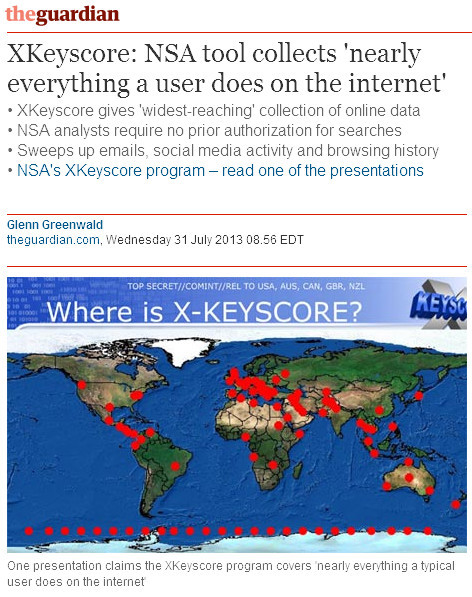
The Guardian - XKeyscore: NSA tool collects 'nearly everything a user does on the internet'
Glenn Greenwald: A top secret National Security Agency program allows analysts to search with no prior authorization through vast databases containing emails, online chats and the browsing histories of millions of individuals, according to documents provided by whistleblower Edward Snowden.

The NSA boasts in training materials that the program, called XKeyscore, is its “widest-reaching" system for developing intelligence from the internet.

The latest revelations will add to the intense public and congressional debate around the extent of NSA surveillance programs. They come as senior intelligence officials testify to the Senate judiciary committee on Wednesday, releasing classified documents in response to the Guardian’s earlier stories on bulk collection of phone records and Fisa surveillance court oversight.

The files shed light on one of Snowden’s most controversial statements, made in his first video interview published by the Guardian on June 10.

"I, sitting at my desk," said Snowden, could “wiretap anyone, from you or your accountant, to a federal judge or even the president, if I had a personal email".
Greenwald reports that XKeyscore’s capabilities were denied by congressional leaders; “US officials vehemently denied this specific claim. Mike Rogers, the Republican chairman of the House intelligence committee, said of Snowden’s assertion: ‘He’s lying. It’s impossible for him to do what he was saying he could do.’"

It would seem that either Rogers himself was lying or that the full extent of the NSA’s snooping was kept even from him.

The system is ripe for abuse. “Under US law, the NSA is required to obtain an individualized Fisa warrant only if the target of their surveillance is a ‘US person’, though no such warrant is required for intercepting the communications of Americans with foreign targets," according to the report. “But XKeyscore provides the technological capability, if not the legal authority, to target even US persons for extensive electronic surveillance without a warrant provided that some identifying information, such as their email or IP address, is known to the analyst."

In other words, it’s illegal to use XKeyscore to snoop on your ex-wife, but there are no other safeguards to guarantee it won’t be abused. The program creates a database that allows you to “search by name, telephone number, IP address, keywords, the language in which the internet activity was conducted or the type of browser used." So pretty much any sliver of information will bring you a pile of data.The potential for blackmailers or stalkers is tremendous and, as I’ve pointed out before, even if you trust this president completely with all this info, he’s not the only one who has access. After all, Eric Snowden himself was just some low-level guy and look what he had access to. Human nature is such that you can’t trust everyone. Someone will abuse this system, if they haven’t already.

Monday, July 08, 2013

So the NSA has my personal info. What could go wrong?

WonkBlog: When stated abstractly, the risk of the NSA violating your privacy may not seem so alarming. The Associated Press reports on an FBI database that provides some concrete examples of how a massive database about Americans can be abused.

The National Crime Information Center database, maintained by the FBI, provides law enforcement agencies across the country with information they need to do their job, including information about outstanding arrest warrants, gang memberships, firearms records, and much more. According to the AP, it serves 90,000 agencies and receives 9 million data points every day.

The New York Police Department says one of its detectives was recently caught using the NCIC database to secretly obtain personal information about two other NYPD officers. Police officials have suggested that the man, who also hacked into several individuals’ e-mail accounts, was trying to figure out “who his ex-girlfriend, also a police officer, was chatting with.”

Another police officer, Gilbert Valle, was convicted in March for using the NCIC database to “help compile dossiers on women that listed their birthdates, addresses, heights and weights,” apparently as part of a “bizarre plot to kidnap, cook and cannibalize women.” Fortunately, the authorities stepped in before the women he had profiled were harmed.
Now, AP reports that “authorities have accused a Memphis police officer of using the NCIC database to leak information to a confidential informant about a watch dealer who the informant believed had stolen a Rolex; a reserve patrolman in Clarkston, Ga., of running names and license plates for marijuana dealers; a Montgomery County, Md., officer of running checks on cars belonging to a woman who later reported that the vehicles had been vandalized; and a Hartford, Conn., police sergeant of supplying database records to a woman who used them to harass her ex-boyfriend’s new girlfriend."

In short, not everyone with access to private information is a good person. Those examples are just the ones we know about. Obviously, we have no way of knowing how many people abused the system and got away with it.

"All of your personal data is in the hands of the same people that run the TSA, the IRS and likely the DMV," explains author Peter Van Buren. “Do you trust all of them all the time to never make mistakes or act on personal grudges or political biases? Do you believe none of them would ever sell your data for personal profit ever? In fact, the NSA is already sharing your data with, at minimum, British intelligence. That’s a foreign government that your American government is informing on you to, FYI."

Van Buren also explains that even if you trust completely the people overseeing the NSA right now, those people won’t be around forever — but that data will. The Electronic Frontier Foundation reminds us that the NSA’s history shouldn’t inspire trust. It was the NSA’s abuse of domestic surveillance that resulted in FISA — which George W. Bush basically ignored. Those who don’t learn from the past…

Nixon resorted to burglary to get information and stay in power, how much more tempting must it be to access information without resorting to breaking into the Watergate Hotel? And the temptation isn’t just for the president, As we see with the NCIC database, the danger of abuse exists with every person involved. If it can be abused, it will be abused. It’s simply human nature.

[image by JefferyTurner]

Wednesday, June 19, 2013

After NSA story, users flock to privacy-protecting search engine DuckDuckGo

Man in DuckDuckGo tshirt stands next to Google sign
The Next Web: Just over a week after passing a record 2 million searches in a single day, DuckDuckGo has announced a new milestone: the company processed 3,095,907 searches [on Monday] . DuckDuckGo made it clear that this stat does not include yesterday’s 18.9 million searches via its API and approximately half a million bot searches.

It’s no coincidence that DuckDuckGo’s stats are climbing as the PRISM and larger NSA surveillance controversy grows. The startup has received considerable attention as a Google alternative — remember, Google was cited as a main data source for PRISM. After facing severe criticism for its involvement, Google appealed to the US government in hopes of sharing more about the data requests it receives.
Asked if the PRISM program could be used to monitor users of DDG, CEO and founder Gabriel Weinberg answered, “…if the NSA were to come to us and ask for all our data, it would not be useful to them because our data is truly anonymous (as opposed to pseudo-anonymous, which is never really anonymous).”

Once again, we see the “the public appreciates and understands the NSA’s efforts” line fall apart. Polls show we’re against it and evidence like this shows that a lot of people are willing to actually do something about it. Besides, when the data collection is so easily thwarted, how can it actually be useful? You might not have noticed, but criminals are kind of secretive, so you’d expect them to have been doing this sort of stuff all along.

[photo by JoakimLagerqvist]

Tuesday, June 11, 2013

The pushback against the surveillance state

Electronic Frontier Foundation: Today, a bipartisan coalition of 86 civil liberties organizations and Internet companies – including the Electronic Frontier Foundation, reddit, Mozilla, FreedomWorks, and the American Civil Liberties Union – are demanding swift action from Congress in light of the recent revelations about unchecked domestic surveillance.

In an open letter to lawmakers sent today, the groups call for a congressional investigatory committee, similar to the Church Committee of the 1970s. The letter also demands legal reforms to rein in domestic spying and demands that public officials responsible for this illegal surveillance are held accountable for their actions.

The letter denounces the NSA’s spying program as illegal, noting:

This type of blanket data collection by the government strikes at bedrock American values of freedom and privacy. This dragnet surveillance violates the First and Fourth Amendments of the U.S. Constitution, which protect citizens’ right to speak and associate anonymously and guard against unreasonable searches and seizures that protect their right to privacy.
The letter was accompanied by the launch of StopWatching.us, a global petition calling on Congress to provide a public accounting of the United States’ domestic spying capabilites and to bring an end to illegal surveillance.
Meanwhile, Nate Silver writes that surveillance could become a wedge between establishment partisans and civil libertarians in upcoming primaries and makes an interesting observation; that the partisan shift shows opinions aren’t set in stone. “[M]any Americans do not hold especially firm views on some issues and instead may adapt them depending on which party controls the executive branch,” he writes. Which means it may not be as difficult to sway opinion as I’d originally thought.

The problem in Washington is fear. Even if an official is inclined to end the surveillance state, they may not want to take the risk. What happens when you end a program and there’s a terrorist attack? No one wants to take the blame for that, which is a big reason why these sorts of programs so often outlive their already dubious usefulness.

If politicians are motivated by fear, then the obvious strategy here is to make them afraid to side with the snoops. This is where the calls, emails, and letters to elected officials make all the difference in the world.

[photo by Milica Sekulic]

Saturday, June 08, 2013

Yes, tech companies accommodated NSA snooping

New York Times: When government officials came to Silicon Valley to demand easier ways for the world’s largest Internet companies to turn over user data as part of a secret surveillance program, the companies bristled. In the end, though, many cooperated at least a bit.

Twitter declined to make it easier for the government. But other companies were more compliant, according to people briefed on the negotiations. They opened discussions with national security officials about developing technical methods to more efficiently and securely share the personal data of foreign users in response to lawful government requests. And in some cases, they changed their computer systems to do so.

The negotiations shed a light on how Internet companies, increasingly at the center of people’s personal lives, interact with the spy agencies that look to their vast trove of information — e-mails, videos, online chats, photos and search queries — for intelligence. They illustrate how intricately the government and tech companies work together, and the depth of their behind-the-scenes transactions.

The companies that negotiated with the government include Google, which owns YouTube; Microsoft, which owns Hotmail and Skype; Yahoo; Facebook; AOL; Apple; and Paltalk, according to one of the people briefed on the discussions. The companies were legally required to share the data under the Foreign Intelligence Surveillance Act. People briefed on the discussions spoke on the condition of anonymity because they are prohibited by law from discussing the content of FISA requests or even acknowledging their existence.

In at least two cases, at Google and Facebook, one of the plans discussed was to build separate, secure portals, like a digital version of the secure physical rooms that have long existed for classified information, in some instances on company servers. Through these online rooms, the government would request data, companies would deposit it and the government would retrieve it, people briefed on the discussions said.
Good on Twitter, huh?

The denials of these tech giants are beginning to look a little dishonest, due to the selectiveness of what they deny. For example, Mark Zuckerberg has a Facebook post up denying he gave the government “direct access” to Facebook servers — without mentioning the “secure portals” NYT reports. These would not strictly be “direct access.” He also says, “We hadn’t even heard of PRISM before yesterday.” The guys who landed at Normandy had never heard of Operation Overlord, either — despite being right in the middle of it. So what? The name of the program was on a need-to-know basis and tech companies didn’t need to know.

But if the companies were legally required to hand over the information, why the smokescreens and selective denials?

“While handing over data in response to a legitimate FISA request is a legal requirement, making it easier for the government to get the information is not, which is why Twitter could decline to do so,” the Times reports.

Yeah, that would explain it.

[photo by Robert Scoble]

Thursday, June 06, 2013

What should be a scandal and won’t be

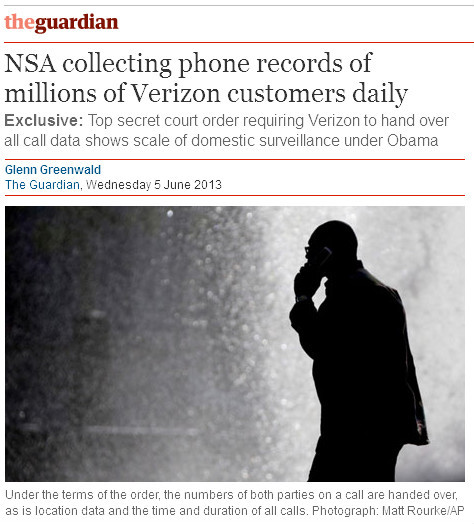
Guardian - NSA collecting phone records of millions of Verizon customers daily
Glenn Greenwald, The Guardian: The National Security Agency is currently collecting the telephone records of millions of US customers of Verizon, one of America’s largest telecoms providers, under a top secret court order issued in April.

The order, a copy of which has been obtained by the Guardian, requires Verizon on an “ongoing, daily basis” to give the NSA information on all telephone calls in its systems, both within the US and between the US and other countries.

The document shows for the first time that under the Obama administration the communication records of millions of US citizens are being collected indiscriminately and in bulk – regardless of whether they are suspected of any wrongdoing.
“Under the terms of the blanket order, the numbers of both parties on a call are handed over, as is location data, call duration, unique identifiers, and the time and duration of all calls,” Greenwald reports. “The contents of the conversation itself are not covered.” So a tiny shred of respect for privacy remains, but this should strike anyone as troubling. As under the Bush administration, the government is spying on citizens — without warrant or even any demonstrable cause for suspicion.

But it won’t get much of a rise out of Washington — even from the scandal-mongering GOP — because Washington is complicit here. This is all extremely legal and above board, thanks to the PATRIOT Act. The neocons pushed for a post-9/11 surveillance state and they got one. You won’t see many of them complaining about it now.

“Given that this will rightly generate a lot of questions today, Congressional Dems and Republicans alike who criticize the news need to be asked why they support the Patriot Act, given that the court order in question explicitly relies on it,” writes Greg Sargent.

Kevin Drum is somewhat more damning, writing with withering sarcasm, “Obviously I’m missing something. After Democrats caved on the surveillance bill in 2007, I simply assumed that this kind of massive data mining of telephone metadata was going to continue forever and everyone knew it. But Glenn suggests that, in fact, this is something surprising. So I guess I assumed wrong.”

Of course, not every critic of this move will be a hypocrite — but those non-hypocritical voices will be the ones Republicans painted as wild-eyed leftist terrorist sympathizers back in the day. And they’re the only ones you should pay any attention to. Like the AP phone records controversy, I doubt anyone else will give this much more attention other than a reaction.

After all, they were all for it before.

Friday, October 10, 2008

Griper Blade: Sex, Lies, and Pointless Wiretapping

Bush fails to use a phone correctlyWall Street and the economy are in flames and the Republican party is smoldering. The party should burst into flames itself about some time in early November.

And one man, smelling strongly of gasoline and burnt matches, tries to blend into the wallpaper. President George W. Bush, widely considered a front-runner for the less than coveted title of "Worst President in History," pops his head up occasionally to make a brief statement, then disappears into the White House in hopes that everyone will forget he even exists. For Bush, the market failure is like a thunderstorm rolling through -- not anyone's fault and totally unavoidable. Both parties in Congress point fingers across the aisle, but no one points to Pennsylvania avenue, where a stupid, stupid man sits nearly forgotten. And he wants to keep it that way.

For the most part, he's been successful. The economy, the market, the election, the two wars he began without any plan to finish them, all keep President Zero off the front page. The lamest of lame ducks, Bush is merely a clockwatcher now, waiting to clear out his desk and start his foundation to promote his lousy ideas (no, he doesn't plan to go away).

But the ghosts of old lies and crimes poke at him, driving him out into sunlight. His neocon paranoia and his contempt for constitutional principles will continue to follow him around long after he leaves office and even into the grave. His shiny new neocon think tank for a New American Century will suffer from its association with its founder -- a man with such powerful organizational skills that he once lost a fair fight to a pretzel...

[CLICK TO READ FULL POST]

Tuesday, July 15, 2008

Former US Atty: Ashcroft Forced Out

clipped from rawstory.com
In an interview with the Dallas Morning News, former U.S. Attorney David Iglesias, who was at the epicenter of the recent U.S. attorneys scandal, claims that former Attorney General John Ashcroft was "pushed out" for his refusal to sign off on an administration wiretapping order.
The one really intriguing question I've had was from a book buyer a few months ago who asked whether I thought John Ashcroft had been pushed out or not after he refused to sign off on the warrantless wiretaps. That's something that a journalist has never asked me. The honest answer is, yes, that had Ashcroft done the wrong thing, the unconstitutional thing, and signed off on it, he'd probably still be the AG. But Ashcroft served honorably. He did the right thing, and he paid the price. He was asked to move on.
For the record, Iglesias is pushing a new book, "In Justice." Still, this doesn't really seem all that wild an accussation, given the history of the Bush admin. and Iglesia's own story.

Wednesday, May 16, 2007

White House Privacy Board Just Another Bullshit Panel

The Bush administration's war on truth continues:

Associated Press:

The lone Democrat on a White House privacy board has abruptly resigned, citing disagreements with the Bush administration over the board's role in protecting civil liberties.

Lanny Davis, a Washington lawyer and former Clinton White House counsel, said this week he no longer believed the five-member board was sufficiently independent to provide robust oversight of controversial government surveillance programs.

Leaders of the Sept. 11 commission pointedly criticized the board last week for not doing its job and questioned many of the findings in the board's 49-page annual report to Congress.


It turns out that Bushco has been editing the panel's report. 'Substantial' edits, according to reports.

When the truth is your enemy, you're not fighting with the good guys anymore.

Search Archive:

Custom Search